
Translation result
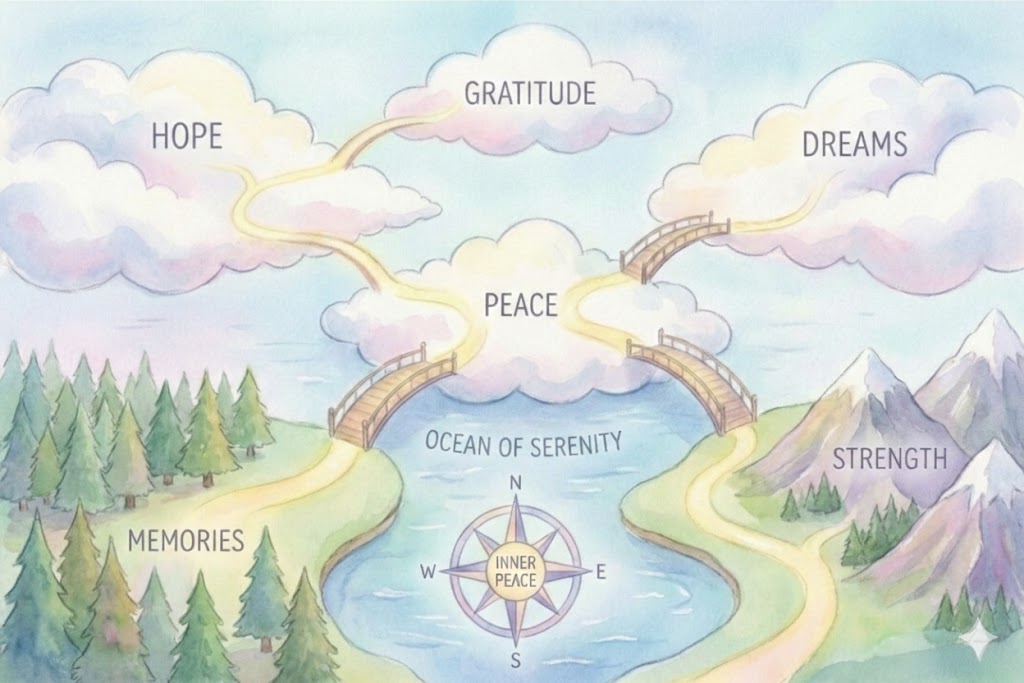
InnerMap_Shortcuts Experiment Note
When and how does the path that fits me appear?
After last week’s column on finding shortcuts, here is this week’s experiment note.
This isn’t a how-to guide for the fastest routes.
Rather, it’s an invitation to learn what kinds of paths suit you now.
■ Time
: 30–40 minutes
■ What you’ll need
: a notebook, one pen, and a route you’ve been walking lately
■ Before you start
Routes shift with time.
The shortcuts you relied on in your 20s aren’t the same as those in your 40s. The way you move when you’re alone is different from how you move while caring for someone. A path that felt effortless in a lighter season can feel very different after you’ve had to let things go.
We often measure ourselves against older routes and ask, “Why can’t I do it like I used to?” But perhaps the route hasn’t deteriorated — your conditions have changed.
You know more now, you’re a bit more complex, and you walk with more care.
Today’s experiment asks you to walk and to notice the paths you take.
■ Step 1 — Identify your current walking conditions
The same route can feel entirely different depending on who walks it, when, and in what state. Start by listing your current conditions.
Age and physical state: How is your body moving these days? Are you sleeping well? Getting enough rest? When are you most alert?
Relationships and roles: Who are you walking with? Are you alone, leading someone, or leaning on someone?
The season and environment: In the season of work, where are you now? Are you running full tilt, catching your breath, or changing direction?
Writing these down will help you see why some days go smoothly and others don’t.
■ Step 2 — Pinpoint when you perform at your best
Think of a recent moment when things unexpectedly clicked. It doesn’t have to be dramatic — a meeting that flowed, an afternoon when writing came easily, or a conversation that felt natural.
Note that moment and the conditions around it.
| What went well | Conditions then |
| Time of day: | |
| Alone / With others: | |
| Physical state: | |
| What I did just before: |
Ask yourself:
At that moment, what was I holding? What was my state and mindset?
Those clues point to the kinds of paths that work for you now.
■ Step 3 — Examine what feels “not like before”
Write down one recent situation where you felt, “It’s not like it used to be.”
Then ask:
Have I really lost the ability, or have the conditions changed?
For example:
• Working late has become harder → Your body’s rhythm has shifted
• Crowded places feel draining → You’re using your energy more selectively
• Decisions take longer → You’re weighing more factors
Next to the example, write:
“I might be walking a path under different conditions right now.”
■ Step 4 — Create annotations for your personal shortcuts
Shortcuts aren’t one-size-fits-all. Different conditions call for different routes. Fill in these prompts.
• What I do best when I’m alone →
• What I do better with someone else →
• What works best for me in the morning →
• What only clears up by evening →
• What’s good to do when my body feels light →
• What I can surprisingly do even when I’m exhausted →
• What comes back into rhythm each changing season →
This becomes your map of shortcuts — not a single star, but many annotated footnotes.
■ Step 5 — Remember you are always walking new paths
Over time you’ve changed routes many times: new cities, new relationships, new work. Each time you learned an unfamiliar path from scratch, and at some point it became yours.
Write down the routes that felt strange at first but later became familiar.
One last question:
Are you still learning new routes? If so, you’re not lost — you’re widening the path.
■ This week’s small experiment
Option A — Change the time: Do a task you usually do at a fixed hour at a different time. Move a morning task to the evening, or try a night routine in the early morning. Observe what changes. Did the path change, or did you?
Option B — Change one condition: Do the same task under different circumstances. Try something you usually do alone with someone else; swap music for silence; switch from sitting to walking. What shortcut did you find today?
We often think we’re lost.
We feel stuck. But maybe we’re learning a new route under different conditions.
And if you think about it, we’ve always done this: hesitated before an unfamiliar path, then made it our own.
Shortcuts don’t disappear. They shift to match who you are now.
What do you like most about the path you’re walking these days?
Ayn (content planner; projects include Bookstore Traveler’s Inspiration Class)














Most Commented