
How ‘La Callas’ Redefines Opera: A Deep Dive into the Emotional Journey of Maria Callas
Daniel Kim Views
Translation result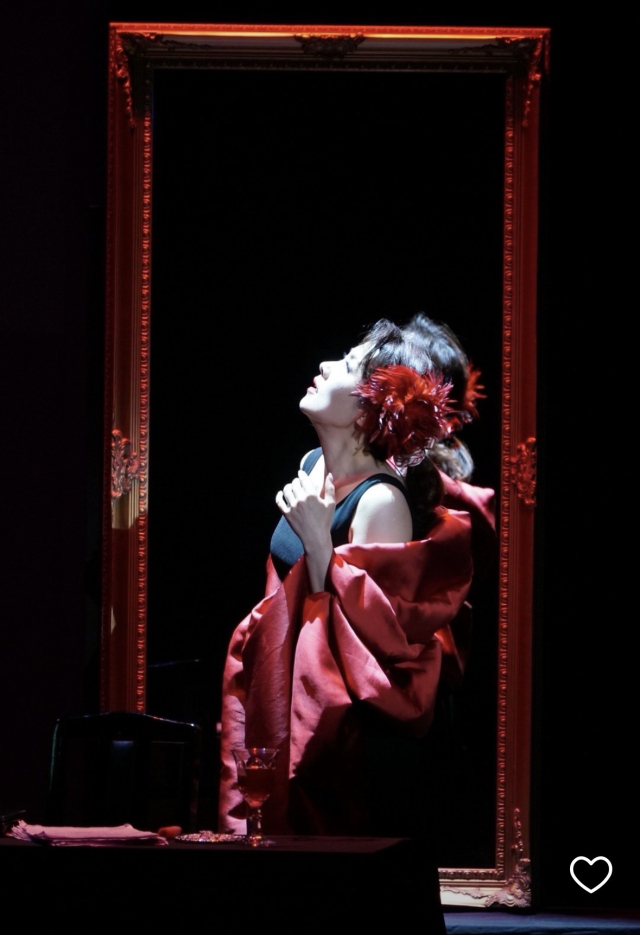

At the National Theater’s Daloreum Theater, the music-drama festival \”Seoul\” (Orpheum Klangark Company, directed by Yu In-chon) staged a program drawn from Schubert and Brahms lieder alongside iconic opera arias. The festival presented four music-dramas: Jeong Hee-kyung’s La Callas; a dramatically staged Winterreise featuring baritone Kim Jun-dong and tenor Kim Eun-guk (piano: Park Hyo-min; ensemble sopranos Jeong Hee-kyung, In Gu-seul, Han Kyung-sung; mezzo Jeong Yu-jin; tenors Kim Jae-min, Kim Eun-guk); Brahms’s only song cycle Die schöne Magelone (soprano Han Kyung-sung; tenor Kim Jae-min; balladeer Jeon Tae-hyun; piano: Lee Eun-hye); and Arias of Dreams, a suite of signature arias and choral pieces — including the Toreador Song from Carmen and La donna è mobile from Rigoletto — performed by a line-up that included sopranos Han Kyung-sung, Jeong Hee-kyung, In Gu-seul; mezzos Jeong Yu-jin, Yoo Hyun-joo; tenors Kim Eun-guk, Kim Jae-min; baritone Kim Jun-dong; bass Jeon Tae-hyun; pianists Kim Mia, Park Hyo-min; trumpeter Lee Hye-jin; and the Met Opera Chorus. The company reimagined lieder, arias and classical melodies as dramatic narratives on stage, and the music’s melodies were staged with striking visual intensity.
La Callas stood out. It borrowed documentary techniques to dramatize Maria Callas’s desires, solitude, artistry and inner life, moving beyond a purely musical presentation into a sensory, theatrical narrative. The production made tangible the artistic isolation and tragic arc of the diva. Winterreise expanded Schubert’s characteristic wanderlust and loneliness through the actors’ emotional trajectories and movement. Die schöne Magelone distilled Brahms’s romantic lyricism into a love narrative, producing scenes that felt at once fable-like and tenderly lyrical. These choices helped set this music-drama festival apart from more conventional offerings.
Jeong Hee-kyung’s La Callas (with tenor Kim Jae-min; Hidalgo played by Kang Hye-kyung; flutist Kim Young-ha; pianist Kim Mia; and the Met Opera Chorus) portrays the tragic arc of Maria Callas — the twentieth-century soprano who lived and burned brightly as a global diva until her death at 53. Rather than a standard operatic portrait, the production reads as the life of an artist staged as drama: Jeong prioritizes theatrical embodiment over pure vocal display. Her performance pays clear homage to Callas and often blurs the line between interpreter and icon. Using a chorus of phantoms, stage objects and documentary material, the work traces Callas’s life across eight signature arias in roughly 70 minutes. Alternating solo and choral passages, it reconstructs the singer’s interior — the anxiety, mania and melancholy that enveloped her — as a tragic operatic monodrama. This is Jeong Hee-kyung’s La Callas.
◇ A theatrical reworking of the opera stage — the festival’s structural experiment
To grasp Jeong Hee-kyung’s La Callas, a bit of context on Maria Callas (1923–1977) helps. Callas transformed twentieth-century opera and became known for making opera profoundly theatrical — delivering arias as acted, psychological performance. Born to Greek parents and active mainly in Italy, she modernized bel canto repertoire (Bellini, Donizetti) for contemporary stages. Even as her voice roughened and cracked, those imperfections served as instruments of emotional truth. Callas didn’t simply sing roles; she inhabited them, so fully that critics began to describe her as an actor-singer. For her, opera exposed a character’s inner and outer life; she became the role she sang. Her portrayals in Norma, La Traviata, Tosca and Lucia di Lammermoor helped reshape expectations for opera performers, shifting attention from mere vocal virtuosity to dramatic presence.
Callas’s blazing career was matched by profound loneliness. As her voice declined, she experienced anxiety and delusion. The 2024 film Maria, with Angelina Jolie as Callas, focuses on the final week of the singer’s life, intercutting her fraying interior world with radiant memories. Haunted by visions after drug misuse, Callas died of a heart attack. Her stormy private life — including a liaison with shipping magnate Onassis and public entanglements involving Jacqueline Kennedy — heightened her mythic status. Jeong rejects conventional operatic presentation and confronts Callas’s love, loneliness, despair, fantasy and ambition through the singer’s signature arias. As a mother, spouse, educator and vocalist, Jeong finds points of identification with Callas and shapes the evening into a personal monodrama, intensifying the drama with vivid visual staging.
◇ The red mirror — an object reflecting desire, death and madness
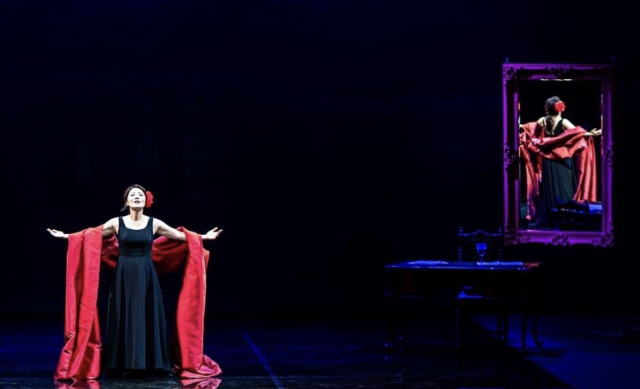
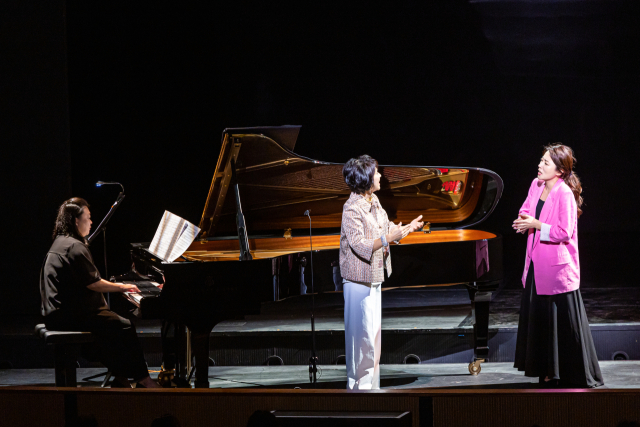
The set diverges from a conventional opera stage. A piano sits stage left; behind a scrim we glimpse everyday moments in Jeong Hee-kyung’s life. She appears as singer, as mother, and as an artist preparing Callas’s arias. Dominating the space is a single red mirror that functions as an objectified interior: it foregrounds Callas’s inner life as if her signature arias still exist in the present. The mirror evokes her glamour and the crises that punctuated her life — death, desire and madness. Callas’s story is a tragedy of artistic glory intersecting with personal ruin, and the red mirror frames her irrepressible passion. The object’s symbolism is theatrical and visually compelling.
Many productions that bill themselves as opera or music drama remain explanatory — offering context, arias or a talk-show format to help audiences follow the music. Jeong’s La Callas opens differently: a reporter appears in the prologue and interviews Jeong as if for a TV news segment, documenting her preparation. Jeong then stages that process. Like Callas, who lived as an actor-singer, Jeong alternates roles: mother, soprano, artist. She dramatizes life’s struggles in dialogue and gradually identifies with Callas, singing arias while embodying the diva’s tragic arc.
Jeong’s acting avoids melodramatic excess. Rather than fragmenting emotions into theatrical flourishes, she stages ordinary moments and candid confessions in conversational speech, which makes her transformation feel authentic. As she crosses between her present and Callas’s past, the audience witnesses an artist becoming another artist. The production visualizes this process more than it reproduces a historical portrait; the scenes are structured like a monodrama centered on Jeong.
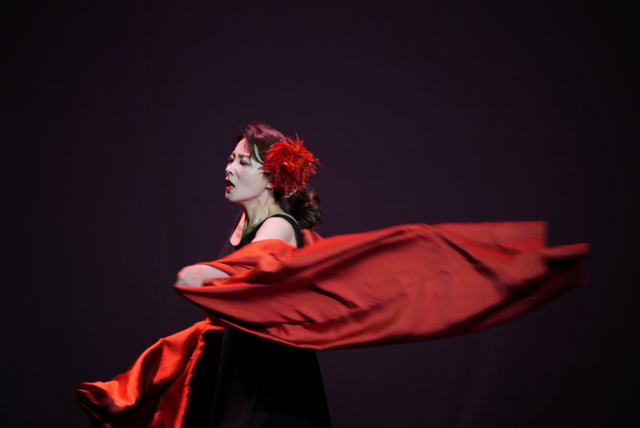
The evening opens with a filmed documentary on Callas’s life, and Jeong’s first aria is Bellini’s Casta Diva from Norma — a signature piece for Callas. Through it, Jeong conveys Norma’s sacred dignity and conflicted interior: the priestess’s sublimity, and the private fear and love that unsettle her. Where some interpreters let melody alone carry an aria’s emotion, Jeong acts the aria in a manner that calls Callas to mind, and the staging amplifies these moments into striking dramatic images. Beginning with Casta Diva, Jeong’s monodramatic stage summons the mythic diva; the red mirror underscores the sense that Callas has become an operatic archetype whose tragic fate the production foreshadows.
Verdi’s La Traviata follows, mapped onto Callas’s world of love and desire. Libiamo ne’ lieti calici signals a glittering apex; Si ridesta in ciel l’aurora reveals the creeping hollowness in Callas’s life; E strano… Ah fors’è lui exposes Violetta’s trembling heart; and Lunge da lei intensifies the conflict between love and reality. As Verdi’s arias unfold, they expand into a narrative of Callas’s humanity, and Jeong’s phrasing frames them as chapters in a life.
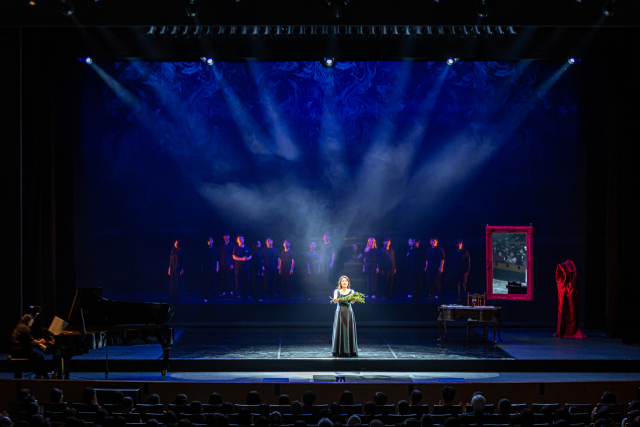
◇ The multilayered theatrical aesthetics of La Callas
What distinguishes the production are the devices used to render arias as layered theatrical narratives. Solo arias are reframed with ensembles and choruses staged as theatrical presences. The chorus functions at times as condensed phantoms of Callas’s interior, a divided self, an observing gaze, or the characters within the arias. The production uses the entire stage, moving the chorus offstage to watch Jeong as Callas, or inserting it into the musical line to form choral textures. At moments the chorus watches with cynical detachment, at others it appears divine, intervening in the drama; at times it offers a collective longing to remember her. These choral interventions operate like a tragic chorus and are a primary structural device in Jeong’s monodrama. Midway through the piece, the production traces Jeong’s gradual becoming-Callas by introducing Hidalgo — presented here as Callas’s teacher and played by Kang Hye-kyung — who functions as a bridge into Callas’s anxious interior.
Puccini’s Vissi d’arte, vissi d’amore from Tosca unfolds like a confession that could be Callas’s own: the melody concentrates the wounds of a life that, despite its pain, never entirely lost its capacity for love. As the red mirror suggests, the aria confronts the audience with the unquenchable passion of a woman who consumed herself in art and love. Addio del passato follows and frames the late-life solitude and internal fragmentation that preceded Callas’s end.
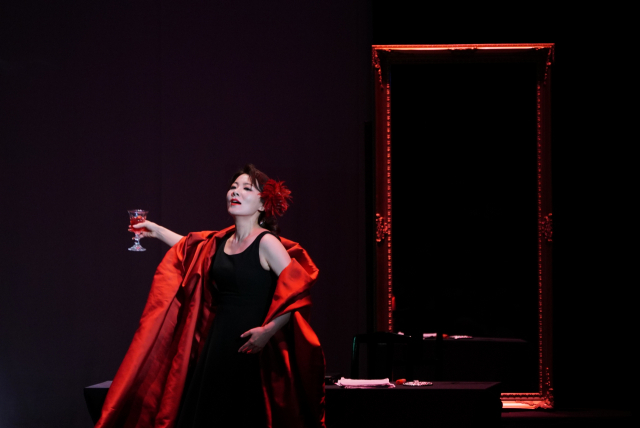 The program’s emotional apex comes in Donizetti’s Il dolce suono… from Lucia di Lammermoor. The mad scene stages Lucia’s descent into madness and overlays it with Callas’s own disintegration. As the second half builds, the scene intensifies into a visualized tragedy: illusion and reality collide, and the music drifts between vision and memory. The red mirror endlessly reflects a fragmented self, amplifying Callas’s despair.
The audience witnesses the tragic soul of a woman who burned herself out in love and art. The finale fuses operatic madness with human loneliness; Jeong’s physical performance reaches its peak as her white dress, soaked in blood, makes the passage toward death painfully visible, signaling the close of Callas’s fierce life. The onstage chorus acts as witnesses — less agents of pity than participants in a collective desire to remember. In that gaze, the human Maria fades while the operatic myth endures, like the red mirror. The production realizes its dramatic, tragic vision by structuring the opera in theatrical terms, and the monodramatic quality that emerges feels like a distinct genre.
Above all, the festival did more than perform lieder and opera arias as sound. It reinterpreted them as dramatic scenes that fuse movement, musical selection and narrative into a unified music-drama form. That experimental framing meaningfully altered the conventional music-drama format. Familiar lieder and opera melodies were placed in dramatic contexts, allowing audiences to follow a story while encountering classical lyric feeling. The stage resembled theater as much as concert hall, and the result was emotionally affecting — especially in the closing sequence.
Kim Geon-pyo, professor, Department of Drama & Film, Daekyung University (theater critic)










Most Commented