
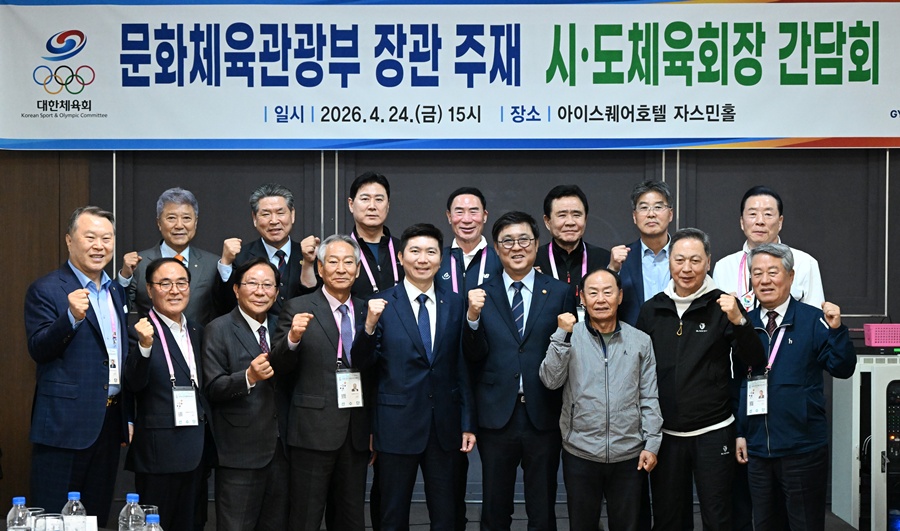
 The Ministry of Culture, Sports and Tourism convened leaders of provincial and metropolitan sports associations to discuss community sports policy and challenges facing local athletics. ⓒKorean Sport & Olympic Committee
[SPOTV News—Gimhae, Reporter Jeong Hyung-geun] The Ministry of Culture, Sports and Tourism and leaders of provincial and metropolitan sports associations met to review community sports policy and the practical issues confronting local sports organizations. While participants agreed on policy priorities, they also raised persistent concerns about funding structures and operating conditions on the ground.
On April 24, the ministry held a roundtable at the Ice Square Hotel in Gimhae, South Gyeongsang, with the Korean Sport & Olympic Committee and leaders from provincial and metropolitan sports associations. Minister Choi Hwi-young and KSOC Chairman Yoo Seung-min attended, along with representatives from all 17 provincial and metropolitan sports associations.
Minister Choi underscored the policy significance of community sports. “Community sports are more than leisure,” he said. “Quality of life is essential for region-led growth, and sports and culture are at the core of that. To keep people in a community, adequate sports facilities and programs must be available.” He expressed regret that this year’s sports budget did not increase substantially and said the ministry would work to align next year’s budget with national priorities and needed support.
Officials from the field pressed for better operating conditions. Yoo Seung-min warned that “the sports sector remains chronically underfunded. Compensation for community sports instructors is inadequate, and many facilities are not freely accessible.” He added that collaboration with local governments becomes increasingly difficult in more remote areas.
They also criticized the current model for national competitions. Yoo pointed out that the National Sports Festival, the Youth Sports Festival and the Community Sports Grand Festival are important platforms, but under the present arrangement host municipalities shoulder disproportionate burdens. With rising costs and limited support, hosting provides little tangible benefit. “It’s a structure with heavy labor and high risk,” he said, calling for structural reforms to reduce host burdens.
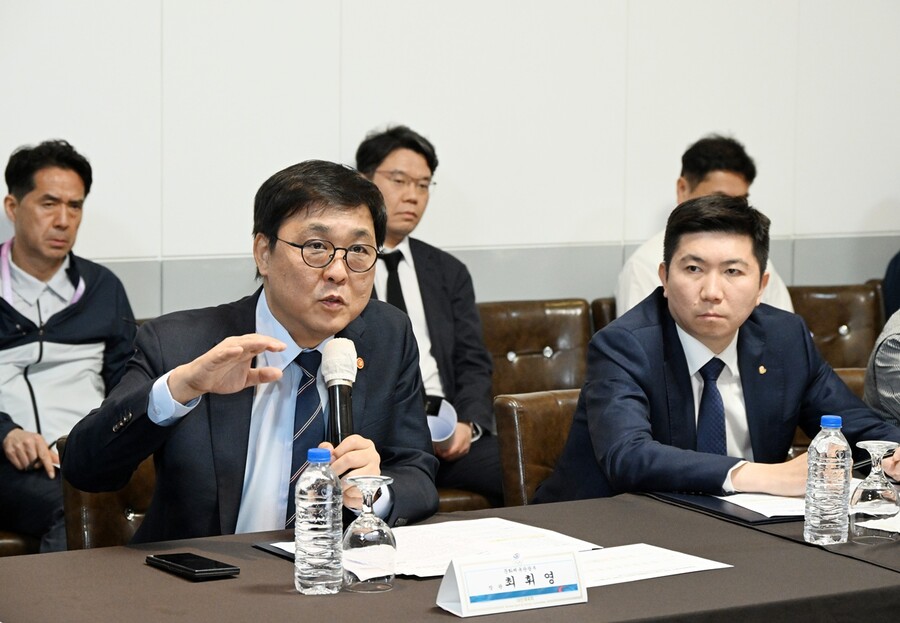 Minister Choi Hwi-young (left) and Korean Sport & Olympic Committee Chairman Yoo Seung-min. ⓒKorean Sport & Olympic Committee
Since local sports councils were established as statutory corporations in 2021, they have gained a legal foundation, but their finances remain heavily dependent on municipal governments. That dependence creates disparities in program delivery across regions and undermines stable operations.
Local sports councils operate through 17 provincial and metropolitan associations, 228 city/county/district councils, and tens of thousands of sport federations and registered teams. Yet payroll, operating, and program costs fall largely on local governments. Leaders warned that low pay and insecure employment for coaches make it difficult to retain qualified staff.
Lee Gyu-saeng, president of the Incheon Sports Council, gave a concrete example: “The meal allowance for National Sports Festival athletes still stands at 6,000 KRW (about $4.50). With a bowl of gukbap now costing more than 10,000 KRW (about $7.50), that allowance no longer reflects reality.” He added that local councils bear a large share of lodging and operational costs and urged reforms to the provincial support framework and expanded funding to stabilize finances.
The meeting also addressed improvements to the election system for local sports council presidents. With elections for provincial and city/county/district sports chiefs scheduled for December, participants stressed the need for fair election administration and stronger administrative support. They also shared progress on proposed legal amendments aimed at stabilizing local sports council operations.
The ministry and the provincial and metropolitan sports leaders agreed on the importance of expanding community sports and revitalizing local athletics. However, how to shore up funding, staffing and institutional support to implement these policies remains an open and urgent challenge.













Most Commented