Quick access to main page (top) Direct access to main contents Quick access to main page (bottom)

EBS Funding Dilemma: Permanent vs. Temporary Income – What You Need to Know

Daniel Kim Views  

▲
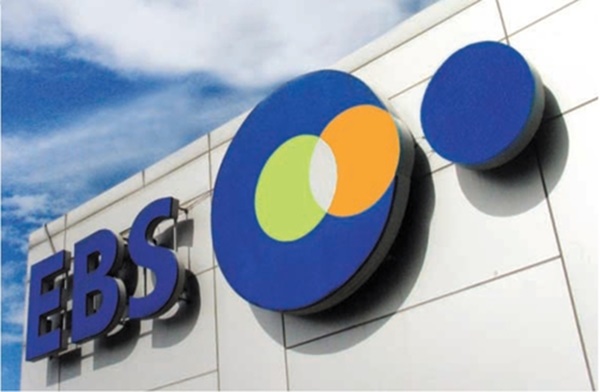
▲ EBS headquarters ⓒEBS

Experts argued that funding for public broadcasters should not be reduced to a simple binary of “public” versus “commercial.” They urged policymakers to recast funding around sustainability and stability, distinguishing “permanent income” from “temporary income.” As the media landscape reorganizes around OTT platforms and market-driven perspectives expand, some participants insisted that discussions about public broadcasting must be approached from a non-market viewpoint.

The Korean Society for Broadcasting (President Kang Jae-won) held a seminar on April 18 at Pukyong National University in Busan under the theme “Public Service Media (PSM) Era: Exploring Sustainable Funding Models for the Future.” Lee Jong-gwan, senior specialist at Sejong Law Firm, proposed evaluating EBS funding not simply as license fees or advertising revenue but by its “sustainability” and “stability”—categorizing revenue as either “permanent income” or “temporary income.” He defined “permanent income” as revenue expected to recur consistently, while “temporary income” is irregular revenue that appears only at certain times.

Lee said government subsidies should be considered “temporary income” because they can disappear when circumstances change or when the implementing body changes. He noted that TV license fees account for only about 5.7% of EBS’s total funding, which makes it difficult for EBS to preserve its public mission and independence based on that source alone. While advertising and program sales are commercial sources, Lee argued they can be seen as “permanent income” so long as markets for ads and program sales continue to exist. He emphasized that public service media must be built on permanent, not temporary, funding because they provide universal services.

Lee also argued that Ministry of Education grants fund education-related projects rather than core broadcasting functions. He urged EBS to decide whether it will prioritize its role as a public service media organization or focus primarily on supplementing public education when determining future funding models. With the broadcast advertising market contracting rapidly, he said guaranteeing sustainable revenue has become difficult and that society must now seriously debate realizing the TV license fee—meaning raising the fee and increasing EBS’s share.

To expand permanent funding, Lee called for institutional reforms that reflect EBS’s distinctive public value and role. He proposed establishing a separate fee-calculation and collection body—such as a “Public Broadcasting License Fee Committee”—and reinvigorating the advertising market through measures like improving bundled ad-sale rules and creating support programs for regional small broadcasters.
▲
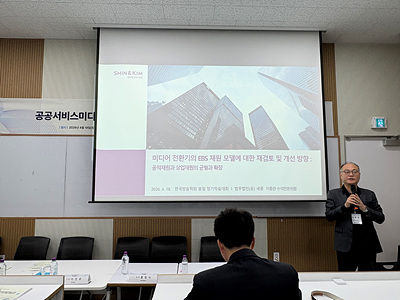
▲ On April 20, 2026, Lee Jong-gwan, senior specialist at Sejong Law Firm, delivered a presentation at the EBS special session of the Korean Society for Broadcasting spring conference. Photo source = EBS.

We must view public broadcasting issues from a non-market perspective

Kim Dae-sik, director of the Sustainability Research Institute, said the question of what kinds of funding are appropriate for public broadcasters is directly tied to restoring their role in defending universal values such as diversity, citizenship and democracy. He called for KBS and EBS to coordinate in restoring public broadcasters’ responsibilities, and argued that realizing a fair TV license fee should underpin that effort.

Yun Jang-yeol, a professor at Sungkonghoe University, argued that platforms like YouTube and Netflix have heavily marketized the media environment. That market-oriented view—where only those who watch public broadcasting should pay the license fee—now pervades the media landscape. He said the media sector needs a balance between public and commercial spheres, and that public broadcasting funding should be approached from a non-market perspective.

Yun added that debates about EBS’s paid content subscription service must proceed alongside funding discussions. He called for public debate on why a public broadcaster charges for content and whether EBS is producing the kinds of content society needs from a public broadcaster.

Hong Won-sik, a professor at Dongduk Women’s University, warned that Ministry of Education funding risks narrowing EBS’s role to strictly educational tasks, such as supplementing public schooling. He said funding should be examined through the question: Why should EBS exist as public service media? Shin Sam-su, head of EBS’s Fee Normalization Task Force, said that as media technology advances, a public discussion about permanent funding is urgently needed so producers can plan more creative, in-depth content.

Daniel Kim
content@tenbizt.com

Comments0

300

Comments0

[Social] Latest Stories

  • Starbucks Korea CEO Fired Over Controversial ‘Tank Day’ Promotion
    Starbucks Korea CEO Fired Over Controversial 'Tank Day' Promotion
  • 25,000 Robots vs. Human Workers: The High-Stakes Battle at Hyundai
    25,000 Robots vs. Human Workers: The High-Stakes Battle at Hyundai
  • Hotel Hygiene Scandal: Cleaner Caught Using Guest Towels to Wipe Toilets
    Hotel Hygiene Scandal: Cleaner Caught Using Guest Towels to Wipe Toilets
  • South Korea’s Tech Giant Kakao Faces First Major Strike in 20 Years
    South Korea's Tech Giant Kakao Faces First Major Strike in 20 Years
  • South Korea’s Aging Crisis: How One Leader Is Redefining ‘Well-Dying’
    South Korea’s Aging Crisis: How One Leader Is Redefining 'Well-Dying'
  • Stop Calling Them ‘Hey You’: South Korea’s New Push for Worker Respect
    Stop Calling Them 'Hey You': South Korea's New Push for Worker Respect

Weekly Best Articles

  • Choi Dong-seok’s Family Bond: How a Simple Engraving Reveals Deep Love for His Children
  • Kwak Sun-hee’s Stunning Wedding Photos: A Celebration of Love and Courage
  • Is ‘I Am a Natural Person’ Just a Big Lie? Comedian Yoon-taek Reveals Shocking Secrets!
  • Health Scare: Why Fans Are Worried About Go Ji Yong’s Dramatic Weight Loss
  • Discover the Winter Gongju Chestnut Festival: A Taste of Korea at H-Mart in the USA!
  • 2026 Spring Wildfire Prevention: How Gyeryong City is Cutting Response Time to 30 Minutes!

You May Also Like

  • 1
    Ukraine’s EU Bid Surges as Hungary Drops Opposition Amid Russian Attacks

    Politics 

    Ukraine’s EU Bid Surges as Hungary Drops Opposition Amid Russian Attacks
  • 2
    Trump Backs Colombia's 'El Tigre' — What It Means for U.S. Relations

    Politics 

    Trump Backs Colombia’s ‘El Tigre’ — What It Means for U.S. Relations
  • 3
    Trump Backs Colombia's Far-Right Outsider—What's at Stake?

    Politics 

    Trump Backs Colombia’s Far-Right Outsider—What’s at Stake?
  • 4
    12.5% Tariff Hit: South Korea Faces New U.S. Trade Penalties

    Politics 

    12.5% Tariff Hit: South Korea Faces New U.S. Trade Penalties
  • 5
    12.5% Tariff Alert: Why the U.S. Is Targeting South Korean Imports

    Politics 

    12.5% Tariff Alert: Why the U.S. Is Targeting South Korean Imports

Popular Now

  • 1
    Marta Kostyuk Makes History at French Open Amid Ukraine Crisis

    Politics 

  • 2
    37 Years in Exile: The Tiananmen Leader Who Just Wants to Go Home

    Politics 

  • 3
    South Korea's Cheongju Airport Faces Crisis as Passenger Numbers Explode

    Politics 

  • 4
    Nuclear Submarine Race: South Korea's High-Stakes Bid for U.S. Fuel

    Politics 

  • 5
    France Finally Admits Complicity in the 1994 Rwandan Genocide

    Politics 

Weekly Best Articles

  • Choi Dong-seok’s Family Bond: How a Simple Engraving Reveals Deep Love for His Children
  • Kwak Sun-hee’s Stunning Wedding Photos: A Celebration of Love and Courage
  • Is ‘I Am a Natural Person’ Just a Big Lie? Comedian Yoon-taek Reveals Shocking Secrets!
  • Health Scare: Why Fans Are Worried About Go Ji Yong’s Dramatic Weight Loss
  • Discover the Winter Gongju Chestnut Festival: A Taste of Korea at H-Mart in the USA!
  • 2026 Spring Wildfire Prevention: How Gyeryong City is Cutting Response Time to 30 Minutes!

Must-Reads

  • 1
    Ukraine’s EU Bid Surges as Hungary Drops Opposition Amid Russian Attacks

    Politics 

    Ukraine’s EU Bid Surges as Hungary Drops Opposition Amid Russian Attacks
  • 2
    Trump Backs Colombia's 'El Tigre' — What It Means for U.S. Relations

    Politics 

    Trump Backs Colombia’s ‘El Tigre’ — What It Means for U.S. Relations
  • 3
    Trump Backs Colombia's Far-Right Outsider—What's at Stake?

    Politics 

    Trump Backs Colombia’s Far-Right Outsider—What’s at Stake?
  • 4
    12.5% Tariff Hit: South Korea Faces New U.S. Trade Penalties

    Politics 

    12.5% Tariff Hit: South Korea Faces New U.S. Trade Penalties
  • 5
    12.5% Tariff Alert: Why the U.S. Is Targeting South Korean Imports

    Politics 

    12.5% Tariff Alert: Why the U.S. Is Targeting South Korean Imports

Popular Now

  • 1
    Marta Kostyuk Makes History at French Open Amid Ukraine Crisis

    Politics 

  • 2
    37 Years in Exile: The Tiananmen Leader Who Just Wants to Go Home

    Politics 

  • 3
    South Korea's Cheongju Airport Faces Crisis as Passenger Numbers Explode

    Politics 

  • 4
    Nuclear Submarine Race: South Korea's High-Stakes Bid for U.S. Fuel

    Politics 

  • 5
    France Finally Admits Complicity in the 1994 Rwandan Genocide

    Politics 

Share it on...