
Why Are Young Men Struggling in Korea’s Job Market? Insights from the Latest Bank of Korea Report
Daniel Kim Views
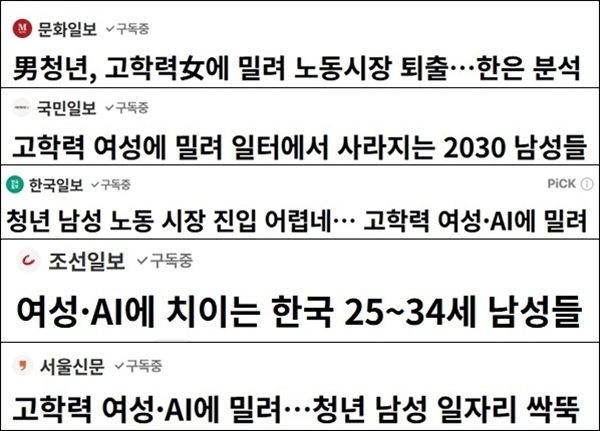
On April 14, a wave of headlines declared that young men are losing jobs to highly educated women. Drawing on a Bank of Korea report released that day, these stories cast highly educated women as a key reason why young men are having trouble finding work. The accounts argued that rising labor-force participation among highly educated women intensified competition in the job market and, as a result, pushed down participation rates among young men.
In its report, the Bank of Korea’s employment research team identified several drivers of the decline in young men’s labor-force participation: shifts in competition within cohorts, structural changes in industry, population aging, and the spread of artificial intelligence. On the gender question, the team noted that occupational segregation by gender has eased—especially in professional and clerical jobs once viewed as male domains—creating situations in which highly educated men and women can substitute for one another in the labor market. The researchers argued that this diversification can promote a more efficient reallocation of human resources and boost overall productivity. They also called for policy measures to reform labor-market structures and reduce employment rigidities.
Many outlets seized on the word “women” in their headlines and used loaded language such as “pushed aside by women” and “crushed by women.” Examples include Kukmin Ilbo’s “2030 Men Disappearing from Workplaces, Pushed Aside by Highly Educated Women,” Munhwa Ilbo’s “Young Men Pushed Out of the Labor Market by Highly Educated Women…Bank of Korea Analysis,” Hankook Ilbo’s “Young Men Struggling to Enter the Labor Market…Pushed by Highly Educated Women and AI,” and Chosun Ilbo’s “Korean Men Aged 25–34 Hit by Women and AI.” These headlines reduce a complex phenomenon to a zero-sum narrative, implying that women are blocking men’s employment and framing the decline in male participation as women taking jobs men once held. That framing turns coverage into divisive scapegoating.
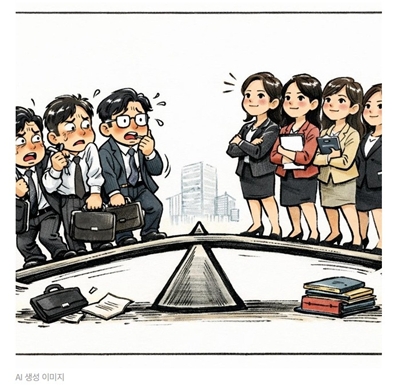
Those headlines quickly created a women-versus-men conflict in public discourse. Comment sections filled with hateful posts such as “Korean women are making men suffer” and “They’re everywhere—women who won’t marry or have kids.” Munhwa Ilbo published an AI-generated image that placed men and women on opposite pans of a scale: timid men with frightened expressions facing confident women. The image explicitly stoked misogyny.
Although most outlets included the report’s detailed analysis and policy recommendations in their articles, the conflict-oriented framing established by the headlines proved difficult to reverse. On April 21, Lee Hae-su, a research professor at Sogang University’s Media Convergence Institute, told MediaToday that by choosing passive, victim-centered language in headlines—phrases like “pushed aside by women,” “disappearing from workplaces,” and “being pushed out”—the media had already set the narrative. Even when structural factors appear later in the text, the initial “women vs. men” impression tends to stick. This is a classic tactic: simplify complex social issues into a conflict to attract clicks.
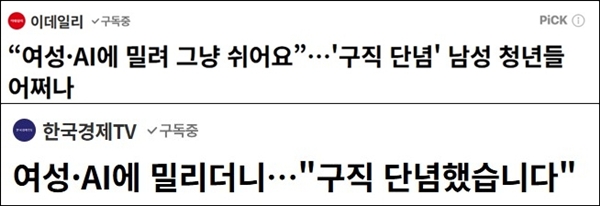
Some headlines even attributed invented quotes to young men. Edaily’s ““Pushed by Women and AI, I’m Just Resting”…What About Young Men Who Gave Up Job Hunting?” and Korea Economic TV’s “Pushed by Women and AI…“I Gave Up Looking for Work”” treated statistical findings as if they were firsthand, emotional testimonies. Professor Lee warned that while readers tend to respond rationally to raw numbers, enclosing those figures in quotation marks invites emotional identification. That personification distorts the data’s meaning and encourages an emotional public response, amounting to a form of manipulation.
Critics also point to limitations in the report itself
Analysts have also cautioned that problems can arise when quantitative, statistical findings—like those in the Bank of Korea report—are translated into social narratives. The research team used cohort analysis to examine factors affecting labor-force participation among men and women. This method decomposes changes in participation into cohort effects, period (time) effects, and age effects; cohort effects reflect the characteristic labor-market participation tendencies shared by groups defined by birth year.
Professor Lee said the approach is useful for identifying drivers of the phenomenon, but from a sociocultural perspective we should pay attention to a broader rupture: the collapse of the modern male breadwinner model that lies behind the gender variable. If statistics show a probabilistic pattern—”more women, fewer men”—without richly explaining the changes in the nature of work and the reconfiguration of family models behind that pattern, the data can easily be misread as evidence of a simple gender confrontation.
He added that the analysis may not fully capture the sociocultural contexts shaping young people’s lives in Korea. The existential cynicism and anxiety young people experience in a dualized labor market cannot be reduced to the dry economic phrase “increased competition.” The more statistically rigorous a report is, the greater its interpretive responsibility to explain context so its findings are not consumed as provocations that stoke social conflict.
Other critics called out clear limitations in the report itself. By placing gender at the center and focusing primarily on the decline in young men’s labor-force participation, the study gave insufficient attention to Korea’s still-low female employment rate, women’s non-participation due to childcare and household responsibilities, and the low wages associated with jobs held by less-educated women. That omission leaves the findings undercontextualized.
Kwon Soon-taek, secretary general of the Citizens’ Coalition for Media Reform, told MediaToday on April 20 that different analytical emphases would produce very different interpretations. “The Bank of Korea centered the ‘young male cohort,’ and even if the report concludes that labor supply has diversified due to shifting social norms and demographics, that framing can still generate gender-based conflict,” he said. “If they had compared Korea’s participation rates to an OECD average of diversified labor supply, they might have found declines among marginalized groups—left-behind women, the less-educated, people with disabilities. Including wages by occupation would yield yet another perspective.”
Kwon criticized the media coverage as lacking initiative. Given the same statistics, he argued, the press failed to move beyond information transmission to pursue alternative readings. “The media chose to emphasize the interpretation that ‘young men are pushed aside by highly educated women,’ a framing that treats gender as a head-to-head battle,” he said. “That only stokes conflict. What constructive contribution does it make to Korean society?”












Most Commented