
How South Korea’s Finance Minister Advocates for IMF’s Role in Global Economic Stability
Daniel Kim Views
Translation result.
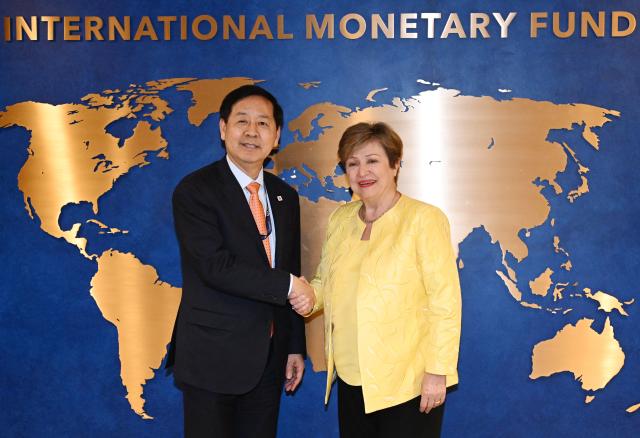
Koo Yoon-chul, deputy prime minister and finance minister, urged the International Monetary Fund on April 17 (local time) to act not as a commentator on crises but as an architect of cooperation — serving as a focal point for global macroeconomic policy coordination and multilateral collaboration.
According to Yonhap, Koo attended the International Monetary and Financial Committee (IMFC) in Washington, D.C., as South Korea’s executive director at the IMF and shared these views with finance ministers and central bank governors from major economies.
The IMF warned that the war in the Middle East has increased uncertainty in the global economy. It emphasized the need for policy responses calibrated to each country’s fiscal and monetary conditions and stressed that structural reform is essential to escape prolonged low growth.
Koo said South Korea has been preparing and executing supplemental budgets quickly without expanding national debt. He highlighted the need for structural reforms during the AI transition and pledged that Seoul will actively support building AI innovation capacity in vulnerable countries.
He specifically urged the IMF to act as a designer of cooperation — coordinating global macro policy and multilateral efforts rather than merely interpreting crises.
Koo later met with IMF Managing Director Kristalina Georgieva and outlined South Korea’s policy direction: swift responses to recent shocks while maintaining fiscal soundness.
He also said South Korea will contribute to developing AI innovation capacity in vulnerable countries, centered on the global AI hub currently under development.
Georgieva said Korea has sufficient fiscal space, and Seoul’s efforts to secure medium-term fiscal sustainability will support stable fiscal management going forward. She expressed strong interest in Korea’s global AI hub initiative and agreed to explore ways to strengthen cooperation in supporting AI capacity building for vulnerable countries.
Koo attended the G7 finance ministers and central bank governors’ meeting at the invitation of France, this year’s G7 chair. He participated in two special sessions on global imbalances and critical minerals and discussed with finance ministers from the United States, Japan, and other key countries how to deepen G7–G20 cooperation to address imbalances.
He argued that if both surplus and deficit countries act simultaneously — rather than expecting only certain nations to shoulder the burden — the negative spillovers from global imbalances can be minimized. He predicted that if economically influential countries and regions lead by expanding investments in human capital, such as AI education, and pursuing structural reforms like pension reform, middle-income and emerging economies will join those efforts.









Most Commented