
Top 7 Performances from the First Ever Seoul-Beijing-Tokyo Music Festival You Can’t Miss!
Daniel Kim Views
Translation result
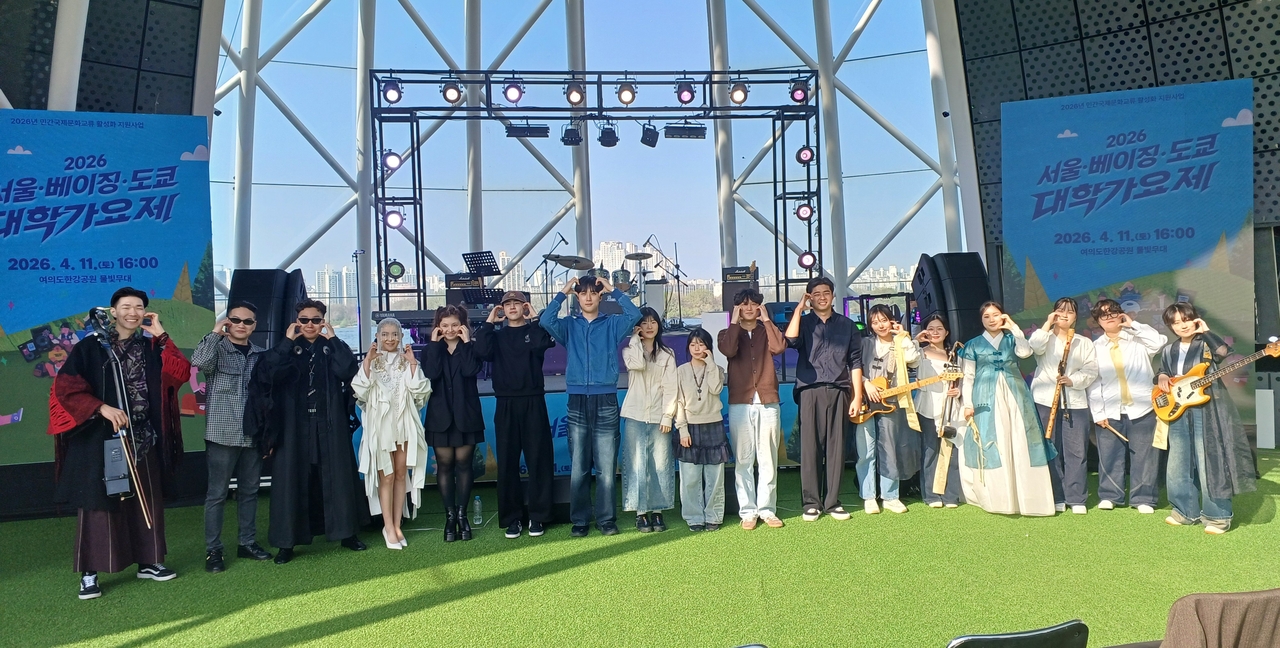
College musicians from Korea, China and Japan gathered for a cultural exchange showcase, cheering one another on and sharing a deep passion for music. Local spectators enjoyed the original songs from the three countries and encouraged the performers with applause and cheers, even when the sets were more earnest than polished.
The young artists met on April 11 at 4:00 p.m. at the Mulbit Stage in Yeouido Hangang Park for the inaugural Seoul–Beijing–Tokyo College Song Festival, where they showed off their skills and connected over common youthful sensibilities.
The three-city festival was sponsored by the Seoul Metropolitan Government and hosted by Korea Culture, Arts and Sports Promotion Co. (Hanmunyeche).
Seven teams participated: two domestic teams representing Seoul, two teams from China grouped under Beijing, and two teams from Japan grouped under Tokyo. A Mongolian youth band performed on a special celebratory stage. Instead of waiting in separate dressing rooms, all the teams sat together in the audience, enjoying and supporting one another’s sets.
The program opened with a group photo of all the teams holding hands to celebrate friendship and the meeting. The first act, Band Morak — four students from Dong-A University in Busan — kicked things off with an upbeat song titled “Idealism.” They radiated a love for music and stirred the crowd with lyrics that urged listeners to “let your body ride the rhythm and be free.” Other teams applauded to help ease the pressure on the opening performers.
As MC Ryu (Ryu Seong-hyun) noted, the second act featured Yuta Koike from Tokyo’s Senzoku Gakuen College of Music, whose vocal tone drew comparisons to Korea’s IU. During the chorus of his song “Only You,” he encouraged the audience to chant the phrase back, and the crowd happily obliged, lifting the energy.
In a celebratory fourth-slot performance, Naraniir from the Mongolian National University of Arts and Culture and Hwangsaeng, an all-female band from Ewha Womans University who closed the show, both delivered fusion sets that blended traditional motifs from their countries with modern arrangements, drawing enthusiastic response.
Naraniir performed “Echo of the Sky,” a new piece created for the event. The four members appeared in traditional costumes and makeup, combining deep Mongolian low-register vocal techniques with a mouth-held traditional instrument that produces bright, percussive tones, and added lively choreography that lifted the atmosphere. Many in the crowd said they were a shoo-in for a popularity prize.
Hwangsaeng’s piece, “Bakta,” depicts the fantastical scene of riding a gourd grown from a seed brought by a swallow. The band’s name references “Hwangjong,” the scale degree equivalent to “do” in Korea’s traditional twelve-tone court system. They opened with a sprightly electric-guitar intro, followed by a warm lead vocal, with daegeum, ajaeng and drums weaving an ensemble that let listeners vividly imagine the gourd-ride through playful rhythmic onomatopoeia.
Yugo, representing Japan’s University of Distribution and Economics, put together a hip-hop set with the song “Babo-ya,” closing with about 10 seconds of break-dance as a showy finale.
Ding Quenhui from Shandong Normal University performed “Time,” a lyrical number that evoked a trot-tinged ballad and captured the audience’s attention. Zhang Xiyue from Chongqing Radio & TV University impressed with an original titled “Qin Shang (琴殇),” pairing the qin — a Chinese zither-like instrument — with a theme of personal sorrow; his clear, high vocal delivery had the cinematic sweep of a film theme.
After roughly an hour of performances, the student musicians from the three countries showcased their talents, then gathered in small groups for commemorative photos to celebrate the exchange. A representative from Hanmunyeche said, “Although the event wasn’t large, it created a space where young people could feel empathy and solidarity beyond national cultural differences,” and expressed hope that it will grow into a sustainable cultural-exchange festival.











Most Commented