

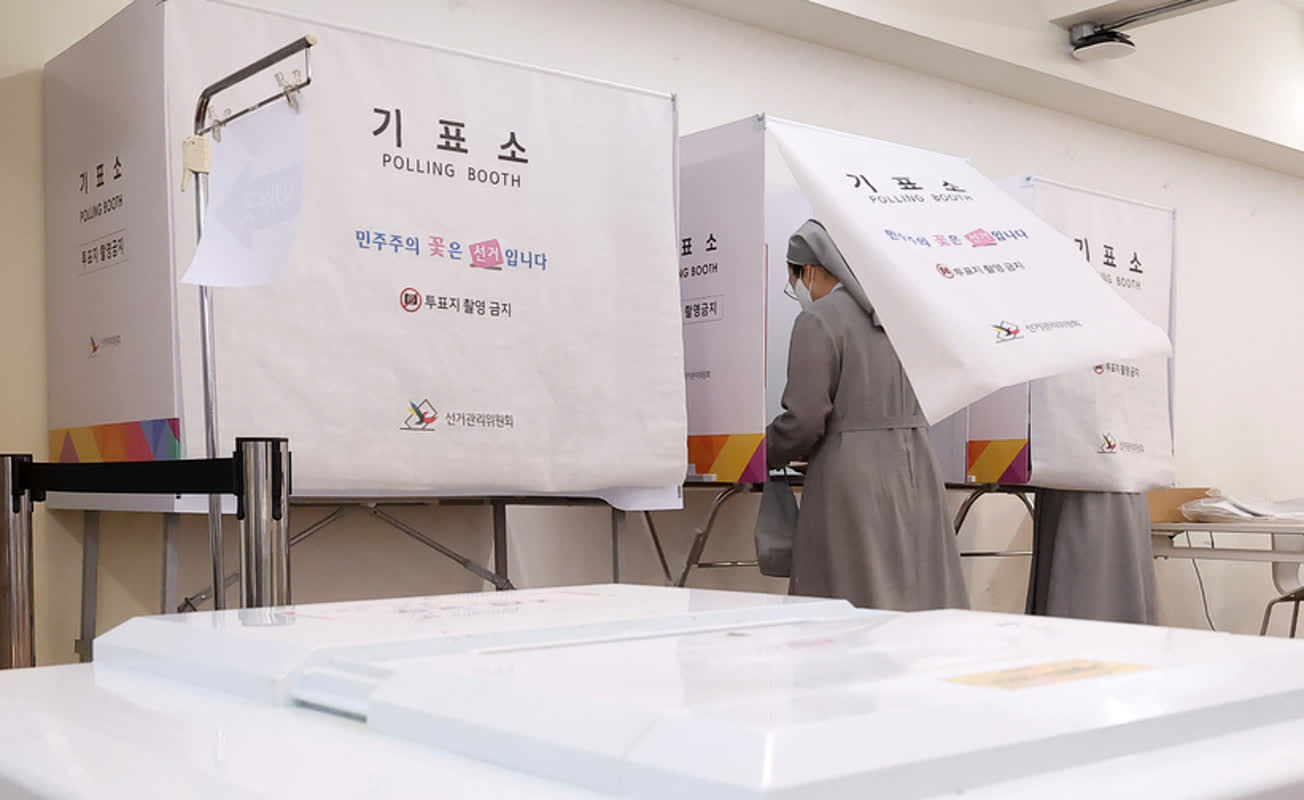
[Point Economy] With 54 days remaining until the June 3 local elections, political tensions in Busan have intensified over nominations for district mayors and metropolitan and local council seats. In the People Power Party, candidates cut off by single-candidate endorsements have filed complaints and lawsuits. The Democratic Party moved quickly to finalize its slate but has not escaped questions about the thoroughness of its vetting. Both parties head into the campaign season carrying internal discord.
◆ Jung-gu and Suyeong-gu: Single-candidate endorsements trigger lawsuits and complaints
Former Jung-gu Mayor Yoon Jong-seo on the 9th filed a complaint accusing Rep. Jo Seung-hwan (representing Busan Jung-Yeongdo) and incumbent Mayor Choi Jin-bong of violating the Public Official Election Act. Yoon alleges he was offered a leadership post at a Busan city agency or a political appointment in exchange for withdrawing his nomination, calling the offer a clear act of bribery.
Rep. Jo immediately denied the allegation, calling the bribery claim “completely false” and saying there was no offer or deal of any kind. With the two sides at odds, the dispute appears likely to develop into a legal battle. In Suyeong-gu, preliminary candidate Hwang Jin-su protested incumbent Mayor Kang Seong-tae’s single-candidate endorsement and demanded a primary.
◆ People Power Party nominating committee confirms single-candidate endorsements and primaries; backlash in Dong-gu and Sasang-gu
On the 9th, the party committee recommended Kang Cheol-ho, chair of the Busan City Council’s steering committee, as the single candidate for Dong-gu mayor and endorsed incumbent Oh Tae-won for Buk-gu mayor. It set a two-way primary between Kim Seung-joo and Kim Young-wook for Busanjin District mayor, a head-to-head between Park Jung-muk and Jang Jun-yong in Dongnae, and a five-way primary in Saha-gu among Lee Bok-jo, Kim Cheok-su, Noh Jae-gap, Cho Jeong-hwa and Choi Min-ho. Twelve metropolitan and local council districts were designated either as single-candidate races or primaries, producing a patchwork of outcomes across the city.
The day after the nominations were announced, protests erupted in Dong-gu and Sasang-gu. Dong-gu preliminary candidate Yoo Soon-hee called the decision a unilateral move that deprived her of any chance to compete, demanded a reexamination, and hinted at filing an injunction or running as an independent. Sasang-gu hopeful Seo Bok-hyun said he detected a pattern of single-candidate endorsements favoring a particular contender, demanded a fair primary, and did not rule out an independent bid. With objections spreading from Jung-gu and Suyeong-gu to Dong-gu and Sasang-gu, the conflict appears to be widening across Busan.
◆ Democrats push a rapid nomination process; women dominate their field
Rep. Jeon Jae-su secured the Democratic Party’s nomination for Busan mayor after winning a majority in the main primary held from the 7th to the 9th. Primaries for district heads in Dongnae, Yeongdo and Sasang are now underway. The party’s nominating committee said it would limit automatic priority slots for multi-term local councilors and former council chairs to expand opportunities for young, female and new candidates. Critics, however, question whether grassroots-level vetting has been sufficiently rigorous.
The two parties’ contrasting approaches to female candidates are striking. Women accounted for 27.6% of the Democratic Party’s preliminary candidates for local district heads in Busan, and as nominations progress the share of female general-election candidates could rise to between 37.5% and 50%. By contrast, the People Power Party has just two female preliminary candidates for district heads—Lee Hye-young in Buk-gu and Yoo Soon-hee in Dong-gu. The Busan Women’s Coalition noted that in the 2022 local elections women won zero metropolitan chief posts and only seven district-head positions (3.1%), and it has called for a 30% quota for female nominations. Observers say Yoo’s protest reflects this broader structural problem.
◆ Incumbent People Power Party officials ‘start early’ amid signs of shifting public sentiment
Several incumbent People Power Party district mayors moved up their campaign timelines—traditionally late April to early May—and have already registered as preliminary candidates. With the Democrats rapidly organizing their slate and expanding their reach in Busan, party officials are watching for signs of changing public sentiment. The memory of the 2018 local elections, when the party lost 13 of 16 districts to the Democrats, still looms large.
The People Power Party’s chief risk is internal overheating: overlapping lawsuits and cutoff disputes have exposed divisions well before the general election. The Democratic Party’s main risk is pace—while it has succeeded in rallying its organization quickly, doubts remain about whether its vetting was thorough enough.
A local political source warned, “With both parties fiercely competing to seize early momentum, the election timeline has effectively accelerated. The race could shift dramatically depending on nomination schedules and how quickly parties organize.”
Ultimately, voters at the ballot box will decide the outcome of these nomination battles. The 54-day countdown to Election Day has begun.









Most Commented