
'5 Poles, 3 Specialties Growth Engines and Regional Talent Ecosystem' Parliamentary Forum Held
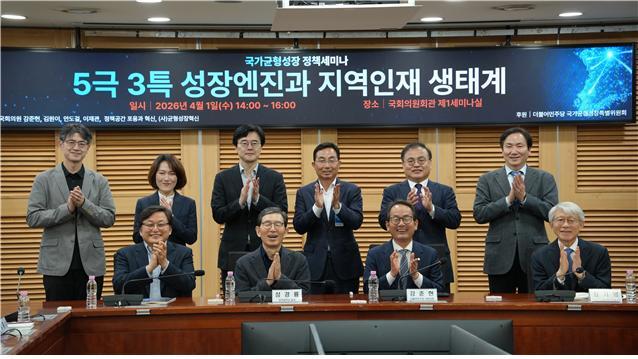
A parliamentary forum titled “5 Poles, 3 Specialties Growth Engines and Regional Talent Ecosystem” was held on April 1 in Seminar Room 1 of the National Assembly Members’ Office Building.
The event was hosted by lawmakers Kang Jun-hyun, Kim Won-i, Ahn Do-geol and Lee Jae-gwan together with Policy Space for Inclusion and Innovation and the Balanced Growth Innovation Association. It was supported by the Democratic Party’s Special Committee on National Balanced Growth, chaired by Kim Tae-nyeon.
The Lee Jae-myung administration has made regionally balanced development—branded as “5 Poles, 3 Specialties”—a top governance priority and a strategic imperative for national resilience. The forum examined policy alternatives to strengthen regional industrial growth engines and the talent-development ecosystems needed to sustain that agenda.
The first presentation, delivered by Kim Young-soo, president of the Small and Medium Enterprise Policy Development Institute, was titled “Strategy to Foster Industrial Growth Engines under the 5 Poles, 3 Specialties Framework.” He noted that earlier initiatives—such as the 5+2 metropolitan economic area strategy—yielded limited results due to the absence of regional coordinators and weak governance. Kim argued that supra-regional zones should integrate industry with culture and tourism, talent development, entrepreneurship, innovation infrastructure and energy, functioning as broad ecosystems and serving as practical growth engines for industry and employment.
As a concrete proposal, Kim recommended establishing Manufacturing AX Innovation Centers that combine manufacturing capacity with artificial intelligence across non-capital super-regions. He suggested training roughly 2,000 young professionals as specialist engineers and creating tech-hub growth engines that connect 63 regional branches of government-funded research institutes and some 500 technology-support organizations—linking their equipment, organizations and personnel across the super-regions.
The second presentation, “Strategy to Build a Regional Talent Ecosystem for 5 Poles, 3 Specialties,” was delivered by Choi Ui-su, former vice president of Silla University. Choi warned that low birth rates, sluggish growth, widening technological gaps and the rise of economic, scientific and technological security make talent a matter of national survival. Yet South Korea’s concentration of core resources in the capital region has created bottlenecks and left non-capital areas economically hollowed out, threatening the national talent-management system.
Choi pointed out that leading growth regions worldwide pursue a Triple Helix model—close collaboration among universities, industry and government—to drive industrial, technological, talent and regional development. He observed that countries such as the U.S., China, Singapore and Japan are fiercely competing to attract and deploy talent. Choi argued that the Lee administration’s 5 Poles, 3 Specialties plan cannot succeed through fiscal transfers and project allocations alone; policy must focus on capability-building so super-regions, provinces and municipalities can sustain development independently. In his view, the policy’s aim should be a capabilities-based state and a national talent powerhouse.
Choi’s first policy recommendation calls for reorganizing K-higher education around a 5+3 functional model and operating innovation-sharing universities. While building regional flagship national universities has value as an anchor for talent development, universities must be functionally differentiated—research-focused, education-focused and vocational-skill-focused—and operate collaboratively within regional talent ecosystems to generate real synergy. In an era of declining enrollments, he said, universities should move away from wasteful competition and toward shared specialization and student-centered innovation-sharing models that maximize learning outcomes.
The second recommendation links the government’s pledged second relocation of public institutions with the creation of K-TechnoPolises. Given the stark disparities in industry and R&D capacity outside the capital, Choi urged using the second relocation as decisive leverage to build national capabilities and grow human capital. He advocated for regional industry–science–academia hubs—modeled on France’s competitiveness clusters—that actively support local industry and talent, not merely serve as administrative outposts.
The third recommendation emphasizes a Global Talent Value Chain. Rather than relying on short-term, revenue-driven recruitment of international students to shore up university budgets, Choi called for a layered strategy: develop a high-quality global education industry like Australia’s and pursue proactive overseas talent attraction policies akin to those in China, the U.S. and Singapore.
The fourth recommendation guarantees universal basic regional living standards with a particular focus on protecting talent and employment rights. High-caliber and young professionals are more likely to remain in regions that offer quality, universal basic services close to home. Ensuring lifelong learning opportunities and stable local employment is especially crucial in an aging society and the AI era.
The fifth recommendation proposes creating a 5+3 regional talent “mega dam.” Instead of confining careers to a single locality, Choi proposed building supra-regional career pathways and combining talent reservoirs with industrial capacity to form super-regional structures that channel human capital into tangible 5 Poles, 3 Specialties outcomes.
In the subsequent discussion, Kim Hong-soo, a professor at Pusan National University and former presidential secretary for education and culture, argued that both industrial growth-engine development and the regional talent ecosystem require a clear control tower. He emphasized integrated, cross-ministerial governance and broad public deliberation to build the social consensus necessary for decisive policy implementation.
Lee Sang-ho, director of the Regional Balanced Development Center at the Korea Institute for Industrial Economics & Trade, urged that regional industrial policy prioritize cooperation rather than a narrow “picking winners” approach. He stressed minimizing policy inefficiencies, cutting unnecessary costs and concentrating resources effectively.
Han Kyung-gu, president of the Balanced Growth Policy Development Institute, said the Lee administration’s 5 Poles, 3 Specialties policy seeks to reorganize industry, population and infrastructure around super-regions. He argued this approach can overcome the limits of traditional administrative-unit policies and catalyze convergent industrial investment and concentrated growth. Han added that the strategy should cultivate an innovation ecosystem that fuses industry, talent and technology and supports autonomous regional development. He concluded that successful implementation will depend on multilayered governance operating organically from the presidential office and the Local Era Committee to the Prime Minister’s Office coordinating ministries, and down to regional and local governments.
Reporter Kim Dong-hong khw090928@viva100.com









Most Commented