
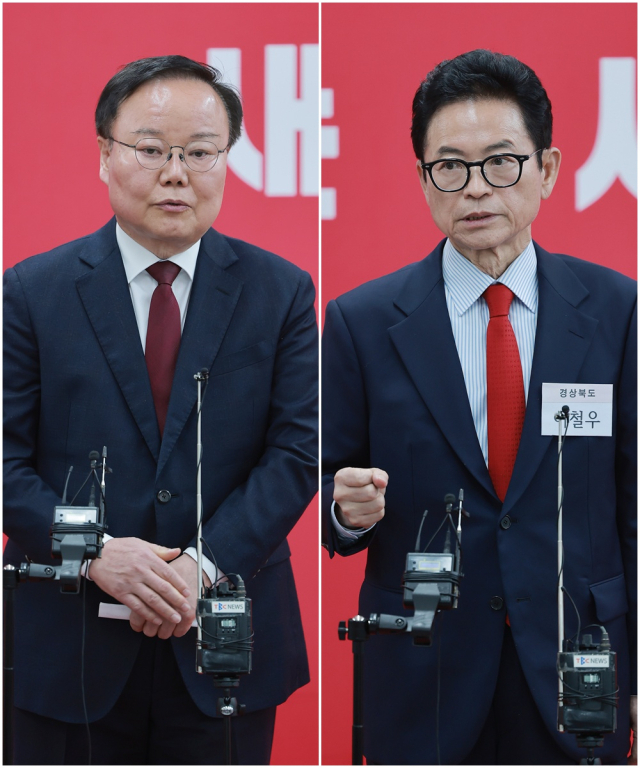
The People Power Party has narrowed its primary for governor of North Gyeongsang Province to a head-to-head between incumbent Lee Cheol-woo—who benefits from an incumbent advantage and strong organizational backing—and Kim Jae-won, who enjoys high name recognition after four terms on the party’s Supreme Council. Kim has mounted a serious challenge by consolidating support from eliminated candidates, and the race has been unsettled since the party extended the primary calendar into mid‑April.
Kim, who dominated the earlier five‑candidate preliminary, pointed to his three terms as a lawmaker, four stints on the Supreme Council, and broad name recognition as the factors that propelled him into the final primary. He now faces Lee’s organizational strength, built over eight years leading the provincial government.
On the 22nd, the People Power Party said it would extend the primary schedule to mid‑April instead of concluding by the end of March as originally planned. Analysts say the longer campaign gives Kim time to strengthen local ground operations that lag behind the incumbent’s.
Kim’s camp plans to use the additional time for sustained public pressure, holding Lee responsible for the collapse of the proposed Daegu–North Gyeongsang administrative integration and pressing investigative scrutiny of various allegations against him.
Lee responded by mobilizing a roster of lawmakers. At his campaign opening on the 21st, attendees included People Power Party floor leader Song Eon‑seok (Gimcheon), Kim Jung‑jae (Pohang North), Im Eui‑ja (Sangju–Mungyeong), Kim Hyung‑dong (Andong–Yecheon), Im Jong‑deuk (Yeongju–Yeongyang–Bonghwa), Cho Ji‑yeon (Gyeongsan) and Lee Dal‑hee (proportional), signaling momentum for the incumbent.
Political insiders say incumbent district lawmakers will carry significant influence in the main primary, where party-member votes account for 50 percent of the result. Lee has emphasized both his organizational advantage and eight years of provincial accomplishments, stressing continuity on major projects such as the airport relocation.
Because both candidates command strong support within the party, many analysts expect undecided voters to determine the outcome.
Lee’s organizational edge gives him a regional advantage, but Kim’s wider recognition across the conservative camp keeps the race tight. With the extended campaign, shifts in voter sentiment driven by mutual attacks and investigative revelations could prove decisive.
A People Power Party official said, “The key question is whether votes from supporters of eliminated candidates will transfer fully to Kim or swing to Lee.”











Most Commented