
Translation result
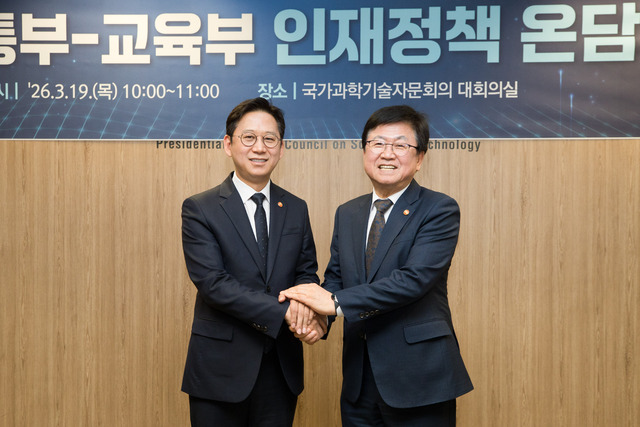
The Ministry of Science and ICT and the Ministry of Education announced they will join forces as a single team to develop advanced talent centered on artificial intelligence (AI).
On March 19, Deputy Prime Minister and Minister of Science and ICT Baek Kyung-hoon and Education Minister Choi Gyo-jin convened a talent-policy roundtable to discuss the initiative.
The two ministries agreed to create effective, end-to-end support measures for talent development. They discussed several key policy goals, including fostering and supporting science and technology talent; innovating AI education and training; building cooperative networks among regional science-and-technology institutes, government-funded research centers, and flagship national universities; and promoting shared use of university research facilities and equipment.
They will establish a policy working council to coordinate policies across the full talent lifecycle—from recruitment through development to active deployment. The council will flesh out joint measures and incorporate them into the 5th Basic Plan for Nurturing and Supporting Science and Technology Talent (2026–2030).
The proposal will be finalized by June after discussion at the meeting of science and technology ministers and review by the National Science and Technology Advisory Council.
The ministries also explored ways to use AI as a catalyst for growth. To strengthen AI instruction in K–12 schools, they plan to build a hands-on AI training platform, issue guidelines for generative AI, integrate AI ethics education, and run joint professional development programs to boost teacher competence.
At the university level, they plan to expand joint research, cross-credit programs, and open access to high-quality courses among the Ministry of Science and ICT’s AI colleges and AI-centered universities and the Education Ministry’s AI hub universities, building regional AI talent pipelines.
To raise AI literacy nationwide, they will produce tailored educational content for different audiences and age groups and promote participation in AI competitions.
To cultivate talent that supports balanced regional growth, they will deepen open collaboration. A Joint Research and Cooperation Program among science-and-technology institutes, government-funded research centers, and flagship national universities will help transform those universities into regional hubs for specialized workforce development and R&D. They will also promote joint faculty appointments to facilitate exchanges of top researchers.
They will encourage shared use of university research facilities and equipment so researchers can access advanced instruments efficiently and produce innovative results.
The ministries plan to align the Ministry of Science and ICT’s reforms on shared use and management of research equipment with the Education Ministry’s related programs, expanding a shared-use ecosystem and staffing dedicated equipment-management teams.
Based on the roundtable discussions, the two ministries will finalize detailed cooperation plans and submit them to the science and technology ministers’ meeting in the first half of the year.
Education Minister Choi Gyo-jin said, “We will join forces with the Ministry of Science and ICT to train talent across the full life cycle—from primary and secondary education to higher education and lifelong learning.”
Deputy Prime Minister and Minister of Science and ICT Baek Kyung-hoon said, “For the nation’s survival and future, we will break boldly from old practices and, as one team, work closely to build an innovative talent-development ecosystem for future generations.”
Hanbit Lee, Reporter hblee@viva100.com









Most Commented