
The citizen jury system was never adopted again after its adverse effects were observed. While I have some reservations, I’ll refrain from commenting on the rules as a candidate. I simply hope the party adheres to its core principles.
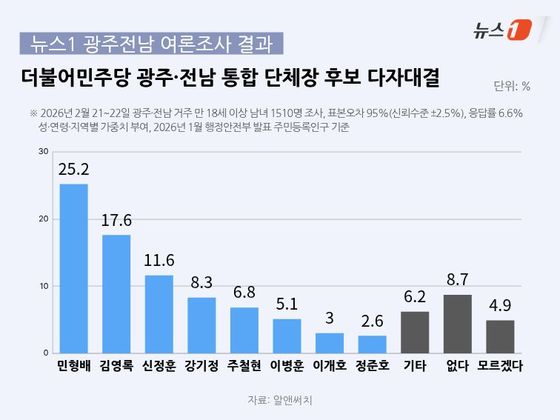
Democratic Party lawmaker Min Hyung-bae, who has declared his candidacy for the special mayoralty of the integrated Gwangju-South Jeolla region, indirectly expressed concerns about the party’s proposed “citizen jury” primary rules.
On the 3rd, during a press conference at the Gwangju City Council briefing room where he was outlining his pledge to attract global high-tech companies, Min addressed questions about the citizen jury primary rules. He stated, “As a candidate, I feel uncomfortable officially commenting on the rules.” However, he added that he believes the party will not significantly deviate from its principles of party member sovereignty, popular sovereignty, and one person, one vote.
When pressed further about the citizen jury system, Min cautioned, “This system, to use a colloquial term, can be easily manipulated. We’ve never adopted it again because we’ve seen its negative consequences in the past.”
He elaborated, “Given that we’re in the process of launching the Gwangju-South Jeolla administrative integration, I have concerns about how a citizen jury would be formed and operated. If it were up to me, I’d reconsider this approach. I’d prefer a method that transparently reflects citizens’ opinions without causing controversy or conflict.”
The “adverse effects of the citizen jury system” Min referred to occurred during the 2010 Gwangju mayoral primary between Kang Woon-tae and Lee Yong-seop.
At that time, the Democratic Party’s central leadership initially planned to conduct the Gwangju mayoral primary using a 100% citizen jury system. However, due to objections from candidate Lee Yong-seop and others, they ultimately applied a 50% citizen jury and 50% party member vote.
In the final tally, Kang, who had ranked third in the citizen jury evaluation, won the nomination by a narrow margin of 0.45 percentage points over Lee. Lee’s campaign subsequently filed for a court injunction to suspend the nomination, alleging that Kang’s associates had interfered with opinion polls. This led to a prosecutorial investigation.
The issue was eventually resolved when the party’s central review committee rejected Lee’s appeal and confirmed Kang’s nomination. However, the incident left significant lingering tensions in the local community.
Meanwhile, the Democratic Party’s Candidate Recommendation Management Committee recently unveiled its proposal for selecting the Gwangju-South Jeolla integrated special mayor candidate. The plan, submitted to the party’s Supreme Council, includes narrowing the field from eight candidates to five through a preliminary election, introducing a citizen jury system for the main primary, and conducting regional touring primaries.











Most Commented