
[Green Economy News = Reporter Lim Chae-young] In the United Kingdom, companies have significantly reduced sugar content in beverages to avoid taxation. When companies alter their recipes, consumer prices may remain stable. (Kwon Deok-cheol, former Minister of Health and Welfare)
While it’s labeled a “burden fee,” the public perceives it as a ‘tax.’ In Australia, despite a decrease in soft drink consumption, adult obesity rates remained unchanged, casting doubt on the sugar tax’s effectiveness. (Lee Sang-wook, Head of the Korea Food Industry Association)
A heated debate erupted in the National Assembly over the introduction of a “sugar burden fee” aimed at curbing childhood and adolescent obesity by taxing sugary drinks. Government officials and academics stressed the critical timing for public health, while industry representatives argued it would be an ineffective tax hike.
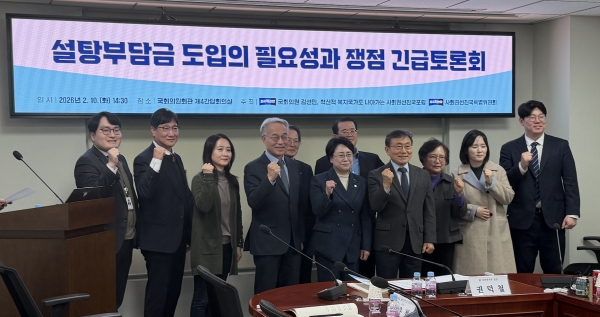
On the afternoon of the 10th, an urgent discussion on the necessity and issues surrounding the sugar burden fee was held in the 4th meeting room of the National Assembly, organized by Kim Seon-min of the Justice Party. Former Minister Kwon Deok-cheol moderated the event, with Professor Park Eun-cheol from Yonsei University presenting. Officials from the Ministry of Health and Welfare, the Food and Drug Safety Administration, along with representatives from academia, consumer organizations, and industry engaged in a spirited debate.
◆ Professor Park Eun-cheol: 80% public support; 240 billion KRW (180 million USD) for public health
Professor Park Eun-cheol emphasized the rationale for the fee, noting that even Adam Smith identified sugar, rum, and tobacco as suitable for taxation. He cited recent polls showing about 80% public support, arguing, “Like the tobacco-lung cancer debate, we must regulate sugar now before it’s too late.”
A concrete plan was presented: The proposed fee on sugary drinks could generate around 240 billion KRW (180 million USD) annually, to be used for enhancing regional and essential public health services. Jeong Hye-eun, Director of Health Promotion at the Ministry of Health and Welfare, supported this, stating that sugary drinks are the primary cause of childhood obesity and emphasizing the need to follow the UK’s approach in encouraging sugar reduction.
◆ Industry pushback: Korea isn’t Mexico; ‘low-sugar’ already trending
The industry’s response was frosty. Lee Sang-wook, Head of Food Safety at the Korea Food Industry Association, argued that regardless of intent, it’s essentially a ‘tax.’ He noted that domestic companies have already tripled their low-sugar product offerings, including zero-sugar options, as part of self-regulation efforts.
Data reveals stark differences between Korea and other countries. According to Euromonitor, Mexico’s annual per capita soft drink consumption is about 163 liters after implementing a sugar tax, while Korea’s is only 50 to 60 liters – just one-third of Mexico’s. Lee pointed to Australia, where reduced soft drink consumption didn’t affect obesity rates, arguing that targeting specific food categories while ignoring obesity’s complex causes could lead to unintended consequences.
Unlike Westerners who often drink soda with meals, Koreans typically enjoy unsweetened coffee (like iced Americanos) after eating, further challenging the need for a sugar tax.
◆ ‘Balloon effect’ and ‘regressivity’ concerns: Will it disproportionately affect the working class?
Potential side effects were highlighted. Ki Yong-ki from the Ministry of Food and Drug Safety warned about overlooking ‘alternative sugars’ (artificial sweeteners). He cautioned that companies might increase use of WHO-discouraged alternatives to avoid taxes, potentially creating new health issues – a ‘balloon effect.’
The most pressing criticism addressed ‘regressivity’ – the disproportionate economic burden on lower-income individuals. Data showed higher childhood obesity rates in lower-income households, suggesting the tax would hit hardest those already struggling with obesity. Samuel Lim, a National Assembly researcher, noted this concern led to the proposal’s rejection in the previous assembly, emphasizing the need for a nuanced approach, such as exempting nutritionally essential foods.
Kang Jeong-hwa, President of the Korea Consumer Alliance, warned of inevitable price increases, potentially further straining working-class family budgets, much like cigarette and alcohol tax hikes.
◆ Real obesity culprits: Delivery apps and trendy snacks, not just canned drinks
Critics argue the root causes of obesity are being misdiagnosed. The presentation showed adolescent obesity rates surged during the COVID-19 pandemic (2019-2021).
This period saw explosive growth in food delivery and high-calorie dining trends like mala hotpot and tanghulu dominating youth diets. Critics contend that while major dietary shifts go unaddressed, the focus is unfairly on taxing easily regulated packaged beverages. Lee Hye-in, a Kyunghyang Shinmun reporter, noted that high-calorie and high-caffeine drinks have been banned in schools since 2009, urging a review of existing regulations’ effectiveness.
While the discussion unanimously supported the noble goal of improving children’s health, it concluded without consensus on whether a ‘tax’ is the right solution. Market concerns persist about whether the government’s targeted 240 billion KRW (180 million USD) will effectively combat childhood obesity or simply burden working-class families during a period of high inflation.














Most Commented