
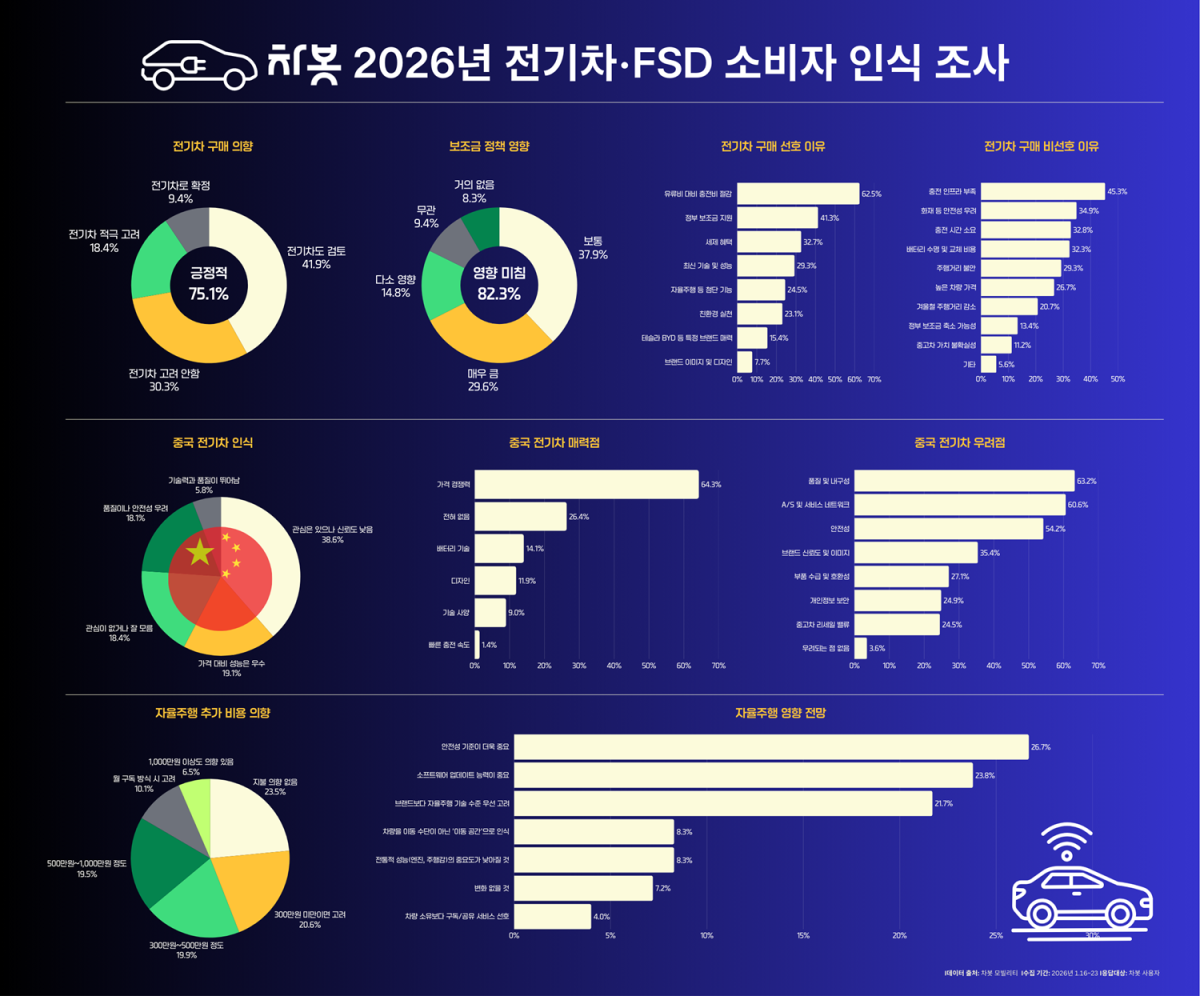
A recent survey reveals that over 70% of potential new car buyers this year are open to purchasing electric vehicles (EVs).
On March 10th, mobility concierge platform Chabot Mobility released findings from a survey of 450 prospective new car buyers, showing that 75.1% of respondents view EV purchases favorably.
Breaking down the numbers, 41.9% consider EVs as a viable option, 18.4% are actively exploring EV purchases, and 9.4% have already decided on an EV. Only 30.3% of respondents ruled out EVs entirely.
The survey found that 100% of respondents in their 20s and 85.4% of those in their 30s expressed interest in EVs. However, interest waned among older age groups, particularly those 50 and above.
Economic factors emerged as the primary driver for EV consideration. A substantial 62.5% of respondents cited lower charging costs compared to fuel expenses as a key factor. Government subsidies (41.3%) and tax incentives (32.7%) also played significant roles in consumer decision-making.
Regarding the influx of Chinese EV brands into the U.S. market, 38.6% of respondents expressed interest but noted lingering trust issues. Interestingly, 19.1% acknowledged these brands’ strong value proposition, indicating their growing competitiveness in the price-performance arena.
When asked about willingness to pay extra for advanced autonomous driving features like Full Self-Driving (FSD), 23.5% of respondents were not willing to pay any premium. However, the majority showed some interest in these features at various price points: 20.6% would consider paying up to 3 million KRW (2,250 USD), 19.9% were open to a 3-5 million KRW (2,250-3,750 USD) range, and 19.5% would entertain costs between 5 and 10 million KRW (3,750-7,500 USD). In total, 76.5% of respondents indicated some willingness to invest in autonomous driving technology.
A Chabot Mobility spokesperson commented, “This survey underscores the rapid transition of EVs from a niche market to a mainstream choice. While Chinese EV brands are gaining traction due to competitive pricing, their long-term success in the U.S. market will hinge on building trust in quality, after-sales service, and safety standards.”











Most Commented