
Translation result
Construction of Samsung and other semiconductor plants will likely face setbacks
If the strike persists, delays and other damages are expected to grow
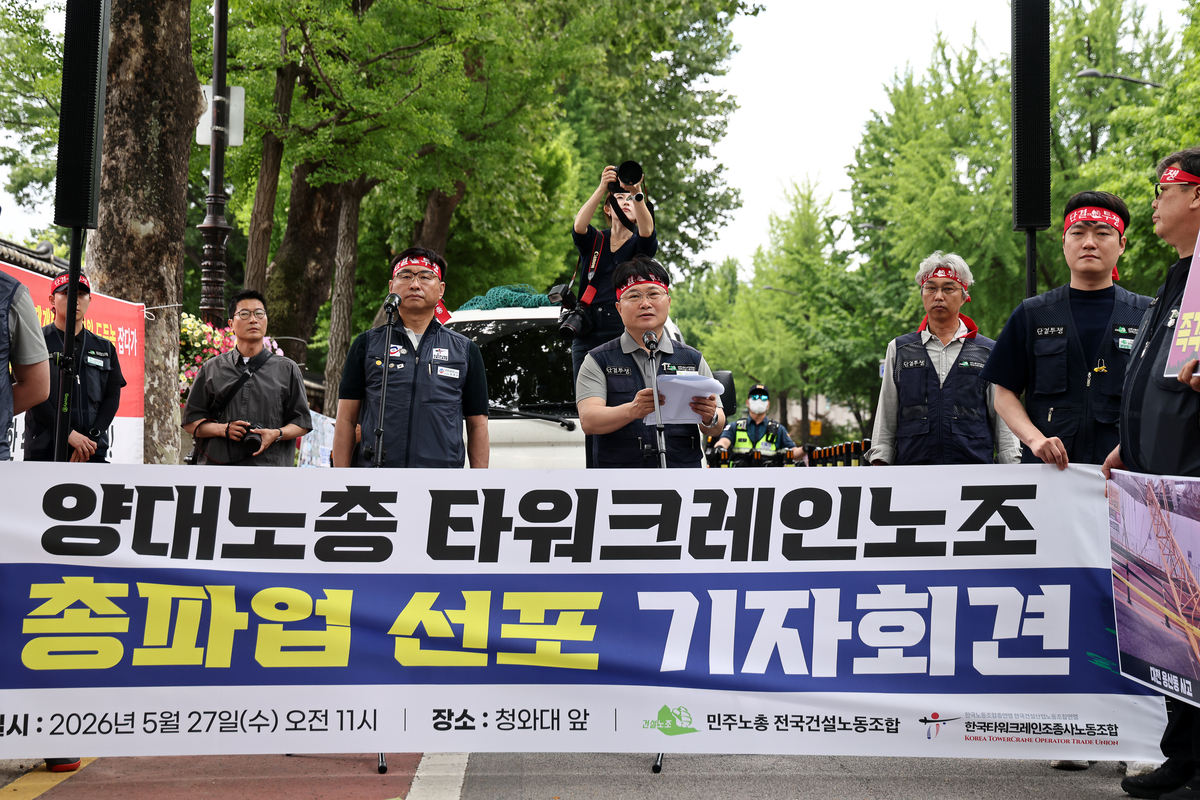 Tower crane unions affiliated with the two major federations have launched a general strike, and disruptions are already being felt across construction sites nationwide. Builders are deploying mobile cranes and attempting to secure nonunion labor as temporary fixes, but they warn that a prolonged stoppage could lead to widespread schedule delays and site shutdowns.
As of May 28, the construction industry reports that tower crane unions under the Korean Confederation of Trade Unions (KCTU) and the Federation of Korean Trade Unions (FKTU) began a general strike the previous day. With roughly 3,100 of about 3,500 tower crane operators belonging to those unions, industry officials estimate that tower crane operations have halted at approximately 90% of construction sites nationwide.
Tower cranes are indispensable not only for high-rise apartments and office buildings but also for plant and public infrastructure projects. The sector is continuing work on internal processes where possible, but industry leaders warn that a prolonged strike could force many sites to stop construction entirely.
A representative from Company A said, “We are continuing interior work that doesn’t require tower cranes, and we’re moving some materials by manpower or lifts,” adding, “Heavy materials like rebar are effectively impossible to transport.”
Company B, which deploys tower cranes at roughly 20 sites, has put replacement equipment into operation at only a handful. “We urgently deployed mobile cranes to six sites where substitution is feasible, but work at the remaining sites has stopped,” the company official said.
Construction firms say their ability to respond is structurally constrained. Typically, when a contractor signs with a tower crane company, that company hires the operators, which limits the contractor’s control over onsite labor.
A Company C official noted, “Union members have occupied the tower cranes, so bringing in nonunion operators is realistically difficult,” and warned, “Forcibly introducing replacement workers could provoke physical confrontations or raise the risk of safety incidents.”
Semiconductor plant construction sites are also on edge. A builder involved in Samsung Electronics’ semiconductor projects said, “For now, we are maintaining workflows using replacement equipment, so immediate impacts are limited,” but added, “We are monitoring the situation closely given the potential for a prolonged strike.”
SK Hynix is experiencing relatively limited effects. At its Yongin plant, the main structural work is largely complete and crews are withdrawing tower cranes, and at its Cheongju plant tower cranes have not yet been required. Nonetheless, industry observers say a prolonged strike could still disrupt subsequent schedules.
The strike began after negotiations between the unions and the employers’ group, the Tower Crane Safety Association, broke down. The two sides held 10 rounds of talks but failed to reach an agreement. The unions demanded a 15% total wage increase and strict adherence to the statutory 40-hour workweek, demands the employers rejected. On the 11th, the unions applied to the Central Labor Relations Commission for post-mediation; when the commission decided to suspend mediation on the 21st, the unions moved toward a strike.













Most Commented