
Translation result.
[iNews24 Reporter Gu Seoyun] As more people look beyond coffee, matcha lattes and milk teas have become staple dessert drinks at chain cafes. But despite their “healthy” or “light” reputations, caffeine and sugar levels vary widely between products — so checking nutrition information is a smart move.
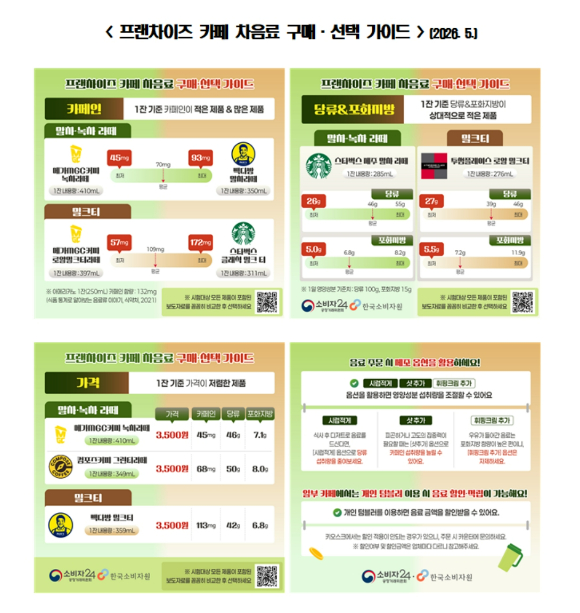
Lab tests showed caffeine per serving ranged from 45 to 172 mg — nearly a fourfold difference across products. Some milk teas actually contained more caffeine than a cup of Americano and also registered high levels of sugar and saturated fat.
On the 28th, the Korea Consumer Agency released results from a study of 12 tea beverages sold at franchise cafes — six matcha/green tea lattes and six milk teas — evaluating quality and safety, labeling practices and pricing.
Overall, caffeine per serving measured 45–172 mg, which is about 11–43% of the 400 mg daily limit recommended for adults. Compared with the 300 mg guideline for pregnant people, one serving represents roughly 15–57% of that limit.
The highest-caffeine drink was Starbucks’ “Classic Milk Tea” at 172 mg per serving. Twosome Place’s “Royal Milk Tea” followed with 148 mg, and Paik’s Coffee’s “Milk Tea” measured 113 mg. Notably, both Starbucks’ and Twosome Place’s milk teas exceeded the Ministry of Food and Drug Safety’s cited caffeine level of 132 mg for a single Americano.
The Consumer Agency cautioned that pregnant people who drink two servings of high-caffeine milk tea could approach or exceed the recommended daily caffeine limit, so extra care is advised.
Sugar levels were also on the high side. One serving of the tested drinks supplied about 26–55% of a 100 g daily sugar guideline. Ediya Coffee’s “Matcha Latte” had the most sugar at 55 g, while Starbucks’ “Jeju Matcha Latte” had the least at 26 g.
Some brands let customers adjust sweetness when ordering through mobile apps. Starbucks, Ediya Coffee and Twosome Place offer options to change sweetness or syrup amounts, but Mega MGC Coffee, Paik’s Coffee and Compose Coffee did not — prompting the Consumer Agency to recommend voluntary improvements from those three brands.
Compose Coffee responded by adding a sweetness-adjustment option for its milk tea and green tea latte and said it is considering expanding the feature. Mega MGC Coffee said it will actively develop lower-sugar products for future launches, and Paik’s Coffee plans to add a syrup-adjustment option.
Declared serving sizes varied even within the same brand and product. The tested beverages averaged 276–410 mL (about 9.3–13.9 fl oz), and checks of 16 servings per product found actual volume differences ranging from 36 mL (about 1.2 fl oz) to 119 mL (about 4.0 fl oz). While made-to-order drinks naturally vary, the Consumer Agency said better production controls are needed to ensure consistent taste and portion sizes.
Safety tests raised no concerns. All 12 products met standards: tests found no residues of three pesticides and no metallic foreign matter.
Prices varied by up to 1.7 times. Per-serving prices ranged from 3,500원 (about $2.63) to 6,100원 (about $4.58). The least expensive items were Mega MGC Coffee’s “Green Tea Latte,” Compose Coffee’s “Green Tea Latte” and Paik’s Coffee’s “Milk Tea,” while Starbucks’ “Jeju Matcha Latte” and “Classic Milk Tea” were the priciest at 6,100원 (about $4.58).
Eco-friendly perks also differed by brand. Paik’s Coffee, Starbucks, Ediya Coffee and Twosome Place offer discounts for using a tumbler, while Mega MGC Coffee and Starbucks provide carbon-neutral point rewards.
The Korea Consumer Agency advised that because matcha/green tea lattes and milk teas contain caffeine, pregnant people and those sensitive to caffeine should monitor their intake. With some products high in sugar, it’s wise to check nutrition information and use sweetness-adjustment options when available.









Most Commented