
Translation result
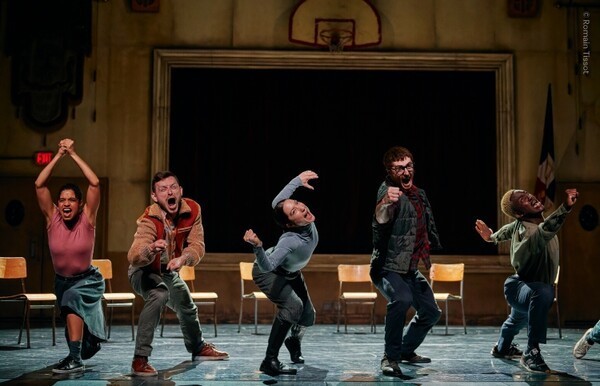
In a worn community hall, a meeting opens not with heroic legend but with a stack of financial records.
The board of Quest Fest, a medieval reenactment group kept alive by ritual and devotion, has gathered for its annual meeting. The scene is prosaic: membership is dwindling, debts are mounting, and the hall itself needs more and more repairs.
Tension builds as a vote approaches. Old bylaws, fading customs and personal loyalties begin to fray across a single table.
Crystal Pite and Jonathan Young turn that last gathering into a 90-minute work of dance theater.
The cast follows the procedures of a formal meeting, but the performance’s power comes through movement. Pre-recorded dialogue rushes ahead while dancers lip-sync and physically inhabit every word, hesitation and emotional turn. Speech lands on the lips, uncertainty settles into the shoulders, and anger travels through arms and backs.
At first, the meeting merely copies order.
The chair runs the discussion. Participants debate agenda items. Some plead passionately to preserve long-standing traditions.
But bodies show the fractures long before parliamentary procedure does.
A figure leans on a folding chair, someone paces the table, a sudden freeze or an unexpected leap—each gesture lays bare anxieties that polite conversation conceals. As the vote nears, the room slowly takes on the look of a battlefield.
What begins as a small assembly for a fading organization widens into a broader portrait of a disappearing community.
The setting is unmistakably a North American community hall—the sort where town meetings and potlucks are held.
A basketball hoop, low ceilings, folding chairs and scuffed floors anchor the piece in the ordinary. Pite and Young then haunt that everyday space with fragments of medieval legend.
The “quest” tucked into the festival’s name has stopped feeling like a game.
Through costume, movement, sound and light, the meeting hall becomes both a ritual site and the ruins of a failed heroic narrative.
One of Assembly Hall’s most compelling tensions sits between humor and anxiety.
The people squabbling over budgets, rules and the fate of a dying event often look absurdly funny. But under the laughter is fatigue: behind each joke is the fear of losing a community, and behind every argument about procedure is the possibility that there will be nowhere left to return.
Rather than magnifying the collapse of a small organization into melodrama, the piece keeps asking why people cling to communities even when those communities seem doomed to vanish.
Pite’s choreography tracks the surface rhythm of language before suddenly pushing beyond it.
Bodies that move in tight sync with rapid dialogue can abruptly expand into broad physical waves. Slow inclinations collide with sharp turns. Fluid motion meets violent stillness. The room’s atmosphere is in constant flux.
A raised hand becomes a request to speak. A curved back reveals years of hidden defeat. Even the angle of a dancer’s feet reshapes the relationships playing out onstage.
Jonathan Young’s collaboration is central to the work’s distinct theatrical language.
Actors’ voices come from offstage while dancers embody them onstage. Audiences hear language while witnessing how it transforms inside the body: syllables, breaths, pauses and moments of sarcasm become rhythmic movement.
Theater and dance don’t explain one another; they sit in productive tension.
Pite and Young made a strong impression with earlier works such as Betroffenheit and Revisor, which probed trauma, loss, bureaucracy and human distortion. In Assembly Hall, they aim that intensity at the ordinary.
Instead of a monumental event, a meeting in a worn community hall takes the spotlight.
As the crisis of a small organization collides with fantasy, deeper questions arise: what is being lost, who keeps holding on, and why do bodies still tremble when people try to preserve stories that look destined to fade?
The production’s creative team tightens its atmosphere.
Set design is by Jay Gower Taylor; costumes by Nancy Bryant; lighting by Tom Visser. Music and sound by Owen Belton, Alessandro Juliani and Meg Roe shift between meeting-room realism and the hum of fantasy. Video design is by Sibylle Young.
Sound, light and space alternate between underscoring the hall’s slow decay and amplifying its mythic resonance.
Assembly Hall premiered on Oct. 26, 2023, at the Vancouver Playhouse in Canada and later played Sadler’s Wells, further cementing Pite and Young’s distinctive fusion of language and movement.
The production went on to win the 2025 Olivier Award for Best New Dance Production.
For Korean audiences, this engagement is a long-awaited encounter. Kidd Pivot’s The Inspector General had been scheduled to tour Korea in 2020 but was canceled by the pandemic. Six years later, this Seoul run marks Pite’s first performance in Korea with her own company.
It also gives local audiences a chance to see work by a choreographer commissioned by major companies worldwide, including The Royal Ballet, Paris Opera Ballet and Nederlands Dans Theater.
Although Assembly Hall borrows from the medieval world, it is not a historical drama.
Its disappearing members, mounting debts, struggling institutions and people who refuse to stop gathering belong unmistakably to the present.
Rather than offering tidy answers, the piece asks what is being lost, who keeps holding on, and why bodies still tremble when they try to keep stories alive.
Assembly Hall will play at LG SIGNATURE Hall at LG Arts Center Seoul from June 5 to 7.
Reported by News Culture M.J._mj94070777@nc.press














Most Commented