
Translation result
[News Culture reporter Lee Jun-seop] Reflection on an era of visual overconsumption is no longer unusual. But When You Walk and Draw, You See the Place — A Chronicle of Emotions on the Road Led by a Sketchbook does more than register that critique: it lays out a concrete route to recovery through embodied movement and the traces left by the hand. The book is a record of trying to reclaim the capacity to stop amid a torrent of fast-moving images.
Author Son Hye-jin identifies a paradox: visual excess can leave us unable to see. Her remedy is simple and embodied—walk, draw, record. The sketchbook is not just a tool; it is a conduit that brings a blurred world back into focus.
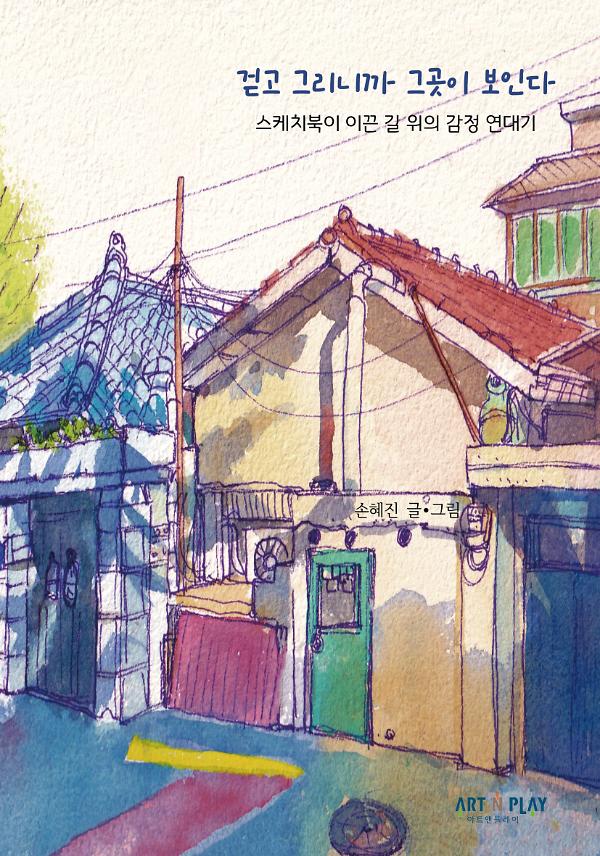
KEYWORD 1 | Slow Sensing
The book starts with a call to slow down. Here, “slow” is not simply a matter of pace; it’s a shift in how we attend to the world. Walking stops being just a way to get somewhere and becomes a way of seeing. Landscapes that used to blur past acquire form the moment your steps slow, and objects and spaces pushed to the margins return as distinct scenes.
That change in tempo alters perception. Your eyes linger; you register not only surfaces but subtleties of texture and consequence. Tiny shifts that once went unnoticed rise into view, and the landscape ceases to be a string of passing images and becomes an event to be experienced. Slow sensing, then, is the starting point for reworking how we relate to the world.
KEYWORD 2 | The Sketching Gaze
The book privileges how you see over how well you draw. Sketching is presented not as a demand for polish but as a means of understanding. Crooked lines and awkward compositions disclose the temporal and improvised nature of the scene, capturing its air and feeling.
When completion becomes the standard, drawings become objects of judgment. Letting go of that standard transforms sketches into records of experience. Accuracy gives way to the intensity of attention: holding a subject for a long time and following it by hand reshapes the act of seeing. Sketching, then, becomes a practice that opens perception rather than simply reproducing the world.
KEYWORD 3 | Rediscovering the City
The zelkova in Jeongneung, unexpected views in Onsu-dong, the steep alleys of Taepyeong-dong in Seongnam — these familiar urban features can suddenly feel foreign. The book traces the city’s periphery rather than its glossy center, revealing a different urban layer. Overlooked spaces acquire new meaning through the act of recording.
A tourist’s gaze reduces places to consumable images; this book lingers with the time embedded in those places. Alley layouts, building marks, and the presence of residents overlap to reframe the city as a network of relationships rather than mere physical space. The city becomes a place to understand and inhabit, not simply to consume.
KEYWORD 4 | Recording Disappearance
To draw a space destined for redevelopment is to provide a final witness to what will vanish and to attempt to hold time in place. Buildings and alleys facing demolition stop being ordinary background and take on new significance as soon-to-be-lost scenes.
Drawing anchors these moments. Scenes that would disappear if only glanced at the eye are imprinted more deeply when they’re slowly transferred by hand to paper. In the process, places are recast as memory, layered with personal experience and feeling.
KEYWORD 5 | Reflecting on the Gaze
The book warns against turning decay into a consumable vintage aesthetic. Old spaces and objects often get reduced to sentimental images, yet they contain the lived time of real people. Recognizing that gap matters.
The author continually audits her own gaze to avoid slipping into a consumerist stance. She refuses to stop at prettiness or sentiment and instead attends to context and traces of life. That stance introduces an ethical tension to recording and deepens observation into understanding.
KEYWORD 6 | Loose Connections
Repeated encounters in the book redefine what it means to connect. A handed snack in an alley, a conversation that starts by chance, a presence that lingers without words — these are alternative forms of relation. They do not hinge on strong obligations or long-term commitments.
These light, passing ties often feel more natural and sustainable. Such loose connections reduce relational fatigue while still allowing people to share warmth. The book reads them as a growing and important mode of sociality in contemporary life.
KEYWORD 7 | Restoring the Body
Impulsive disembarkations in Onsu-dong, sketches made amid market bustle, the continuity of recording even in sweltering heat — these practices reawaken bodily senses. This is not mere hobby; it is a deliberate decision to step away from a life measured by speed and efficiency.
The body ceases to be merely an instrument of movement and returns to the center of experience. Physical sensations — sweat, fatigue, sunlight — come alive again, and life is reorganized across more concrete sensory layers.
KEYWORD 8 | Distance from Nature
Standing before a long-lived tree, emotions are naturally put into perspective. Nature’s time runs far longer and slower than human time, and in its presence personal worries and feelings are rearranged.
The author uses that encounter to set down burdens she had been carrying. Nature functions as a force that helps reset the terms by which she views life.
KEYWORD 9 | The Meaning of Recording
The marks made by hand mean more than images alone. They are the result of time spent observing and experiencing; the process itself becomes the record. If digital images consume moments quickly, analog records accumulate time.
Such records help hold memory, sort emotions, and play a vital role in self-understanding. Recording leaves traces of the world while also serving as a way to protect oneself.
KEYWORD 10 | Sensing as Everyday Life
The book concludes that the senses can be trained. That training is not a special technique but a set of repeatable daily practices. Walking, looking, and recording are simple, sustainable acts.
Over time, repetition becomes a lifestyle and alters one’s rhythm. As perception shifts, so does the way you see the world — and, ultimately, the direction of your life. Rather than grand solutions, the book offers modest, enduring changes and makes a persuasive case for their potential.
When You Walk and Draw, You See the Place stands as both a resistance to a fast-paced era and a record of reclaiming slow perception. Rather than merely explaining how to see the world anew, the book shows how that way of seeing emerges through the body.
News Culture reporter Lee Jun-seop rhees@nc.press














Most Commented